Best Solo Mining Pool in 2026
For miners with significant hash power, the standard pay-per-share (PPS) or proportional (PPLNS) models can feel like leaving money on the table. You’re contributing a substantial portion of the pool’s power but only receiving a fraction of the block reward, diluted by thousands of other participants. Solo mining offers a high-risk, high-reward alternative: you keep the entire block reward (minus a small pool fee) and all transaction fees if your hardware solves a block. This is the ultimate crypto lottery, but one where you can demonstrably improve your odds with more hash rate.
This guide is for miners who understand the risks and are ready to chase the full block reward. We’ll cut through the noise to deliver a data-driven analysis of the best solo mining pool options available today. Instead of just listing names, we’ll break down each platform’s fee structure, payout model, network share, and operational specifics. Our goal is to solve a critical problem: identifying a reliable, low-latency, and transparent pool that maximizes your chances of successfully mining a block alone.
Inside, you will find in-depth reviews of top solo-capable pools, including:
- Solo CKPool
- ViaBTC
- 2Miners Solo
- WoolyPooly
- K1Pool
- SoloPool.org
Each review includes direct links, setup guidance, and a clear-eyed look at the factors that matter most, from minimum payout thresholds to coin support. We analyze the trade-offs between massive multi-coin pools and dedicated single-coin operations, helping you match your hardware and risk tolerance to the ideal platform. This is your definitive resource for making an informed decision in the high-stakes game of solo crypto mining.
1. Solo CKPool
Solo CKPool represents the purest form of lottery-style Bitcoin solo mining, making it a legendary and highly specialized option. It is arguably the best solo mining pool for those who prioritize simplicity, anonymity, and the high-risk, high-reward nature of finding a Bitcoin block entirely on their own. The pool’s philosophy is refreshingly simple: miners connect their ASICs directly to the pool’s stratum servers using their own Bitcoin wallet address as the username. There are no accounts, no registrations, and no KYC procedures.
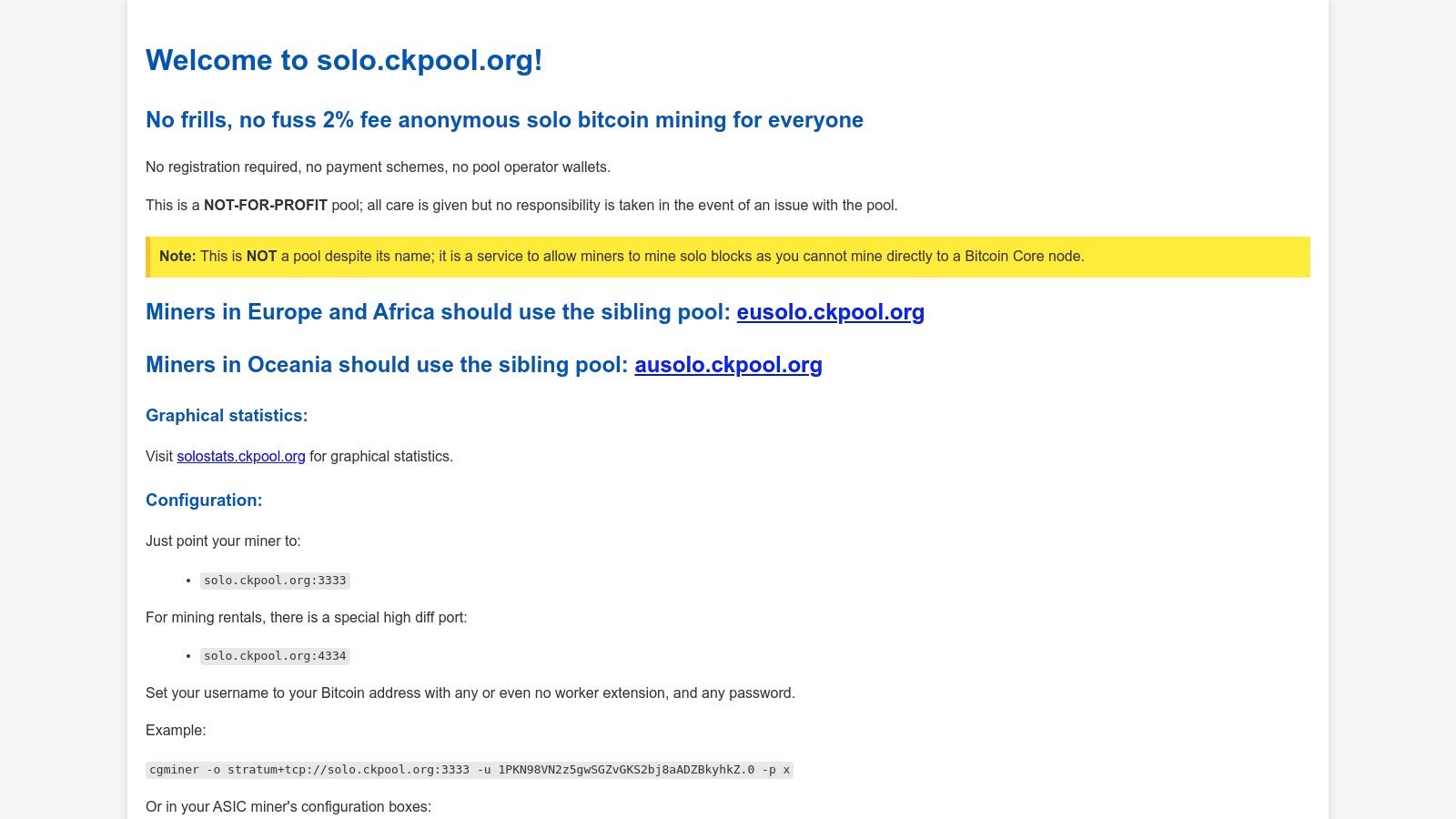
If your hardware successfully solves a block, the entire block reward (currently 3.125 BTC plus transaction fees) is sent directly to your specified wallet address, minus the pool’s 2% fee. This model is the digital equivalent of buying a lottery ticket; the chances of winning are extremely low, but the payout is monumental.
Key Features and User Experience
The primary differentiator for Solo CKPool is its radical simplicity and privacy. The user interface is minimal, focusing on providing essential statistics like network hashrate, block details, and a real-time list of miners who have found blocks. This barebones approach is intentional, catering to miners who value function over form.
- Anonymity: With no account creation, your mining activity is tied only to your Bitcoin wallet address, offering a high degree of privacy.
- True Solo Mining: Unlike PPLNS or FPPS pools, you receive zero payouts unless you personally find a block. This creates extreme variance in earnings.
- Global Stratum Servers: The pool provides multiple regional endpoints (e.g., EU, US, Asia-Pacific) to minimize latency for miners worldwide.
- High-Difficulty Port: A specific port is available for hashrate rental services like NiceHash, which helps manage the high frequency of share submissions from such platforms.
Ideal Use Case and Technical Setup
Solo CKPool is not for everyone. It is best suited for two types of miners: those with substantial hashrate who can statistically expect to find a block over a long period, or smaller miners who want to allocate a portion of their hashrate to this “lottery” as a high-variance play. The process of getting started is detailed but direct, and you can learn more about how to connect your hardware by researching how to join a mining pool.
Configuration Example for an ASIC Miner:
- URL:
stratum+tcp://solo.ckpool.org:3333 - Worker/Username:
YourBitcoinWalletAddress.WorkerName - Password:
x(or anything, as it’s not used)
This straightforward setup has you mining within minutes. However, the extreme variance cannot be overstated. A miner could operate for years without finding a block, earning absolutely nothing in that time. It is a high-stakes endeavor that trades the predictable, fractional income of traditional pools for a chance at the full jackpot.
In summary: Solo CKPool is the gold standard for anonymous, no-frills Bitcoin solo mining. Its simplicity is its greatest strength, but it’s only suitable for miners who can stomach extreme financial risk for a chance at a massive reward.
2. ViaBTC
ViaBTC offers a highly versatile and enterprise-grade approach to cryptocurrency mining, making it a strong contender for the best solo mining pool for those who value flexibility and robust features. Unlike purist solo pools, ViaBTC is a comprehensive platform where miners can seamlessly switch between different payout models, including SOLO, PPS+, and PPLNS, for various coins. This allows a miner to dedicate their hashrate to a high-risk SOLO attempt on one coin while earning stable, predictable rewards via PPS+ on another—all within a single, unified account.
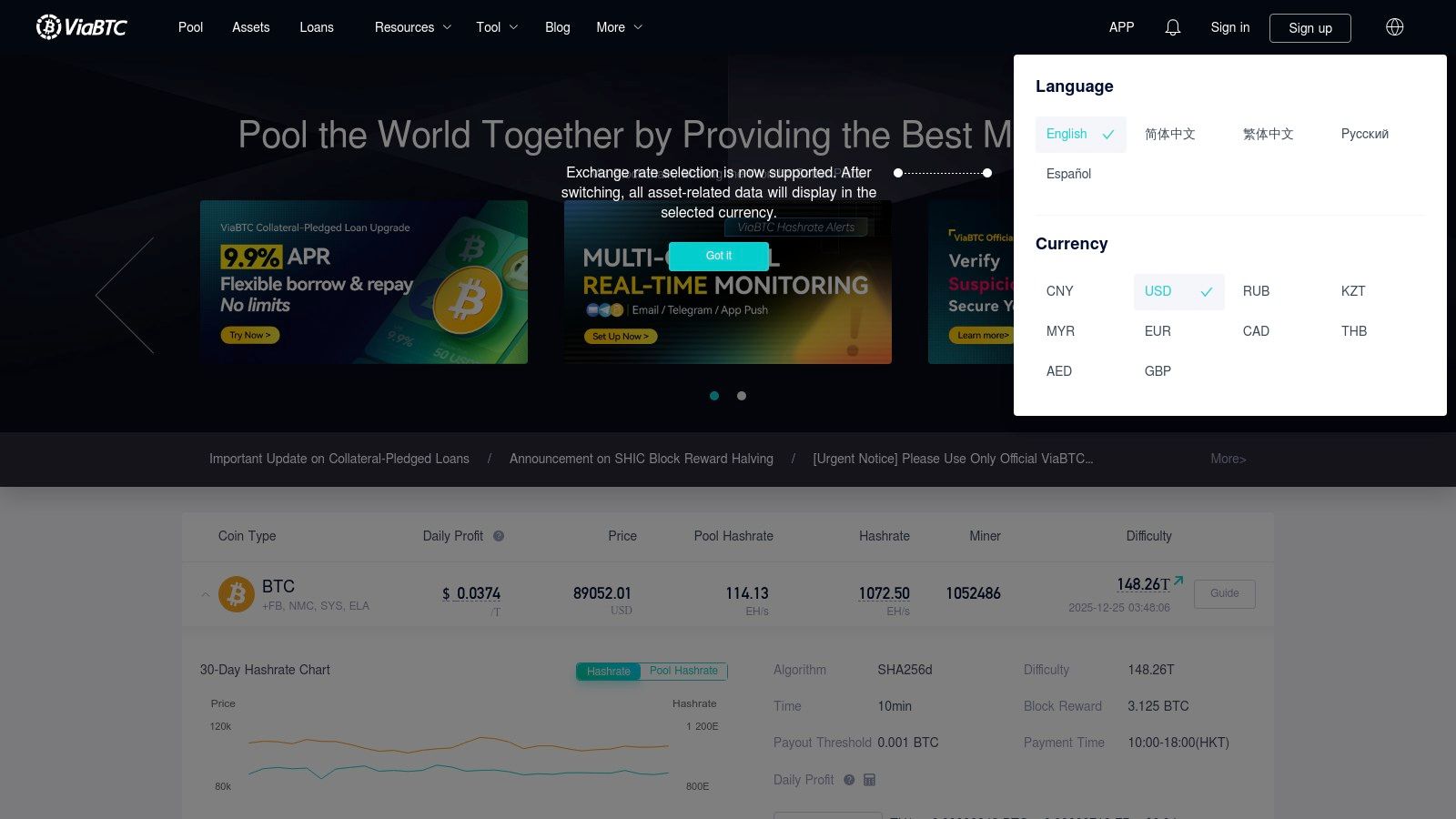
This model caters to miners who want to manage a diverse portfolio of mining activities without juggling multiple platforms. When operating in SOLO mode, if your hardware finds a block, you receive the full block reward plus transaction fees, minus the pool’s fee. While it still involves the extreme variance of solo mining, the platform’s robust infrastructure and monitoring tools provide a professional and controlled environment for taking that risk.
Key Features and User Experience
ViaBTC’s key differentiator is its polished, all-in-one user experience that combines professional-grade tools with the raw, high-stakes nature of solo mining. The platform requires account registration and, in some cases, KYC, trading the anonymity of pools like Solo CKPool for advanced functionality. Its dashboard provides detailed hashrate charts, worker monitoring, and configurable alerts, which are invaluable for serious operations.
- Multi-Mode Flexibility: Effortlessly switch between SOLO, PPS+, and PPLNS payout schemes for each supported coin directly from your account dashboard.
- Enterprise-Grade Tooling: Access sophisticated monitoring, hashrate alerts, and a mobile app to manage your operations on the go.
- Merged Mining: On certain coins like BTC, miners can earn rewards for secondary coins (e.g., VCash) at no additional hashrate cost, adding a small but consistent income stream.
- Global Infrastructure: With servers located worldwide, ViaBTC ensures low latency connections for miners in any region, optimizing share submission and reducing stale shares.
Ideal Use Case and Technical Setup
ViaBTC is an excellent choice for miners who want to experiment with solo mining without fully committing their entire operation to a high-variance model. It suits both large-scale miners who can absorb the risk and smaller miners who wish to allocate a specific machine to a “lottery” attempt while keeping their primary rigs on a stable PPS+ plan. The platform’s advanced features also appeal to professional farm operators who demand reliability and detailed analytics.
Configuration Example for an ASIC Miner (BTC SOLO):
- URL:
stratum+tcp://btc.viabtc.com:3333 - Worker/Username:
YourViaBTCAccountName.WorkerName - Password:
123(or as specified in your account)
Setting up requires creating an account on the ViaBTC website and configuring a sub-account and worker. Critically, you must select the SOLO payment mode in your pool settings for the specific coin.
In summary: ViaBTC is the best choice for professional miners who want both solo and traditional mining options under one roof. The platform’s powerful tools and flexibility justify the account setup and potential KYC requirements, making it a top-tier service for managing mining risk.
3. 2Miners Solo
2Miners stands out as a versatile and user-friendly platform that makes solo mining accessible across a wide array of cryptocurrencies. While many pools focus exclusively on Bitcoin, 2Miners offers dedicated SOLO pools for numerous GPU and ASIC-mineable coins like Ethereum Classic (ETC), Ravencoin (RVN), and Monero (XMR). This makes it arguably the best solo mining pool for miners who want to experiment with solo mining on alternative networks or who operate a diverse fleet of hardware. The platform provides clean, separate dashboards for each coin’s solo operation, simplifying the management process significantly.
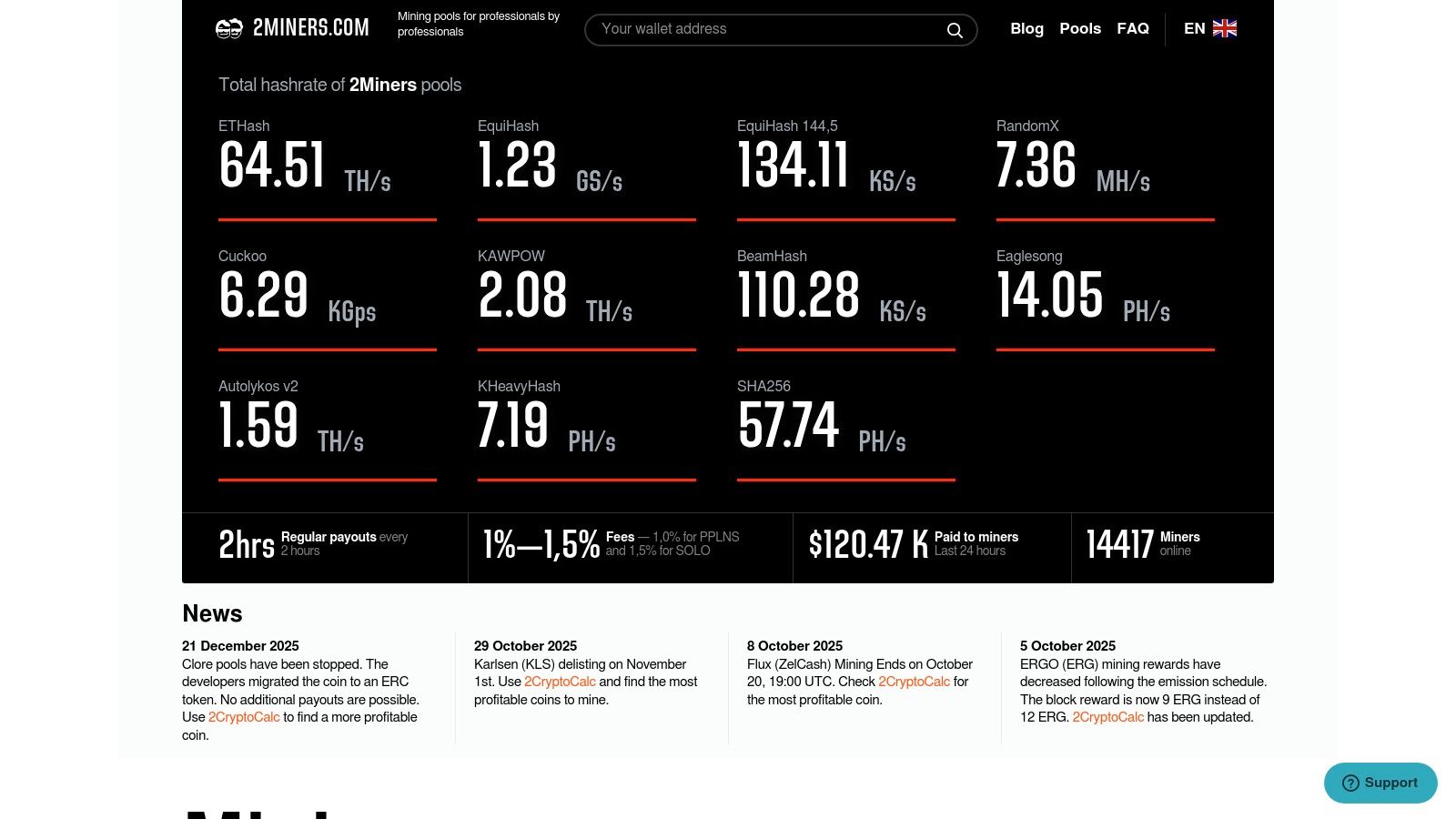
When you mine in a 2Miners SOLO pool, you are competing with other solo miners on the same pool to find a block. If your hardware finds a block, you receive the full block reward and transaction fees, minus the pool’s 1.5% fee. This model retains the high-risk, high-reward nature of solo mining but provides a robust and supportive infrastructure, complete with helpful guides and clear statistics.
Key Features and User Experience
2Miners is celebrated for its polished user interface and extensive support documentation, which lowers the barrier to entry for aspiring solo miners. The platform provides a transparent and feature-rich environment without requiring registration, similar to other privacy-focused pools.
- Broad Coin Support: Offers dedicated SOLO pools for a variety of popular GPU and ASIC coins, giving miners flexibility beyond just Bitcoin.
- Regional Stratum Servers: Provides globally distributed servers (USA, Europe, Asia) to ensure low latency and stable connections for miners everywhere.
- Detailed Statistics: The dashboard for each coin displays your hashrate, shares, rewards, and comprehensive pool-wide statistics without needing an account.
- Active Knowledge Base: Features extensive guides, tutorials, and a helpful support team, making the setup process straightforward for different types of mining hardware.
Ideal Use Case and Technical Setup
2Miners Solo is ideal for miners with significant hashrate on altcoin networks or those who wish to allocate a portion of their GPU or ASIC farm to a high-variance “lottery” on a coin they believe in. The platform’s guides make it easy to start, and using a crypto mining profitability calculator can help you estimate potential outcomes before you begin. Understanding these variables is critical before committing your hardware.
Configuration Example for an ASIC Miner (Ethereum Classic):
- URL:
stratum+tcp://etc.2miners.com:1010 - Worker/Username:
YourETCWwalletAddress.WorkerName - Password:
x(or any)
This setup is straightforward, but the high variance of solo mining remains the primary challenge. A miner on an altcoin network could still wait weeks, months, or longer to find a block, depending on their hashrate relative to the network’s difficulty.
In summary: 2Miners is the go-to platform for solo mining a wide variety of altcoins. Its blend of user-friendly design, extensive coin support, and helpful guides makes it perfect for both seasoned miners and newcomers looking to try their luck beyond Bitcoin.
4. WoolyPooly
WoolyPooly stands out as a versatile, multi-coin mining pool that caters to both collaborative and solo miners, primarily within the GPU and altcoin ASIC mining communities. It’s an excellent choice for miners who want the flexibility to switch between PPLNS (Pay Per Last N Shares) and SOLO mining modes on a per-coin basis. The platform’s strength lies in its user-friendly approach, making it a contender for the best solo mining pool for those mining newer or less mainstream cryptocurrencies like Kaspa, Radiant, or Karlsen.

Unlike hyper-specialized Bitcoin solo pools, WoolyPooly offers a broader ecosystem. For each supported coin, it provides distinct PPLNS and SOLO pools with their own stratum addresses. When you find a block in SOLO mode, you receive the full block reward minus the pool’s competitive fee, which is typically around 1%. This model gives miners a clear path to pursue high-variance, high-reward solo mining on a variety of networks.
Key Features and User Experience
WoolyPooly prioritizes a clean interface and straightforward setup, which is particularly beneficial for miners exploring various altcoins. Each coin has a dedicated page with connection details, fee structures, and pool statistics. This clarity removes much of the guesswork often associated with configuring miners for different algorithms.
- PPLNS and SOLO Options: Miners can easily choose their preferred payout model by simply pointing their hardware to the correct stratum server address for that coin.
- Low Pool Fees: The pool advertises competitive fees, often at 1% or less, which are clearly stated on each coin’s respective page.
- Global Server Network: WoolyPooly maintains servers across multiple regions (Europe, USA, Asia) to ensure low-latency connections for its global user base.
- Integrated Tools: The platform includes helpful resources like profitability calculators, detailed setup guides, and monitoring integrations via Telegram bots.
Ideal Use Case and Technical Setup
This pool is ideal for miners with mid-to-high-end GPUs or specific ASICs who want to solo mine promising altcoins. The risk is still significant, but finding a block on a smaller network can be more statistically probable than on the Bitcoin network. It allows miners to speculate on the future value of a coin by accumulating full block rewards.
Configuration Example for a Karlsen (KLS) Miner:
- URL:
stratum+tcp://pool.woolypyooly.com:3102 - Worker/Username:
YourKarlsenWalletAddress.WorkerName - Password:
x(or your choice)
Because WoolyPooly focuses on altcoins, miners must be aware of market volatility and network difficulty changes, which can drastically affect profitability. The minimum payout thresholds also vary by coin, so it’s essential to review the specifics before committing your hashrate.
In summary: WoolyPooly is a top choice for altcoin miners who want low fees and the flexibility to switch between PPLNS and SOLO mining. Its broad support for emerging coins makes it an excellent platform for speculative solo mining.
5. K1Pool
K1Pool offers a distinct and highly organized approach to solo mining, positioning itself as a premier destination for miners interested in altcoins rather than Bitcoin. It is arguably the best solo mining pool for those looking to experiment with solo mining various GPU and ASIC-mineable cryptocurrencies. The platform’s strength lies in its clear segmentation of SOLO pools by algorithm and coin, providing a structured environment where miners can easily find and test their luck on networks like Kaspa, Ethereum Classic, and Ravencoin.
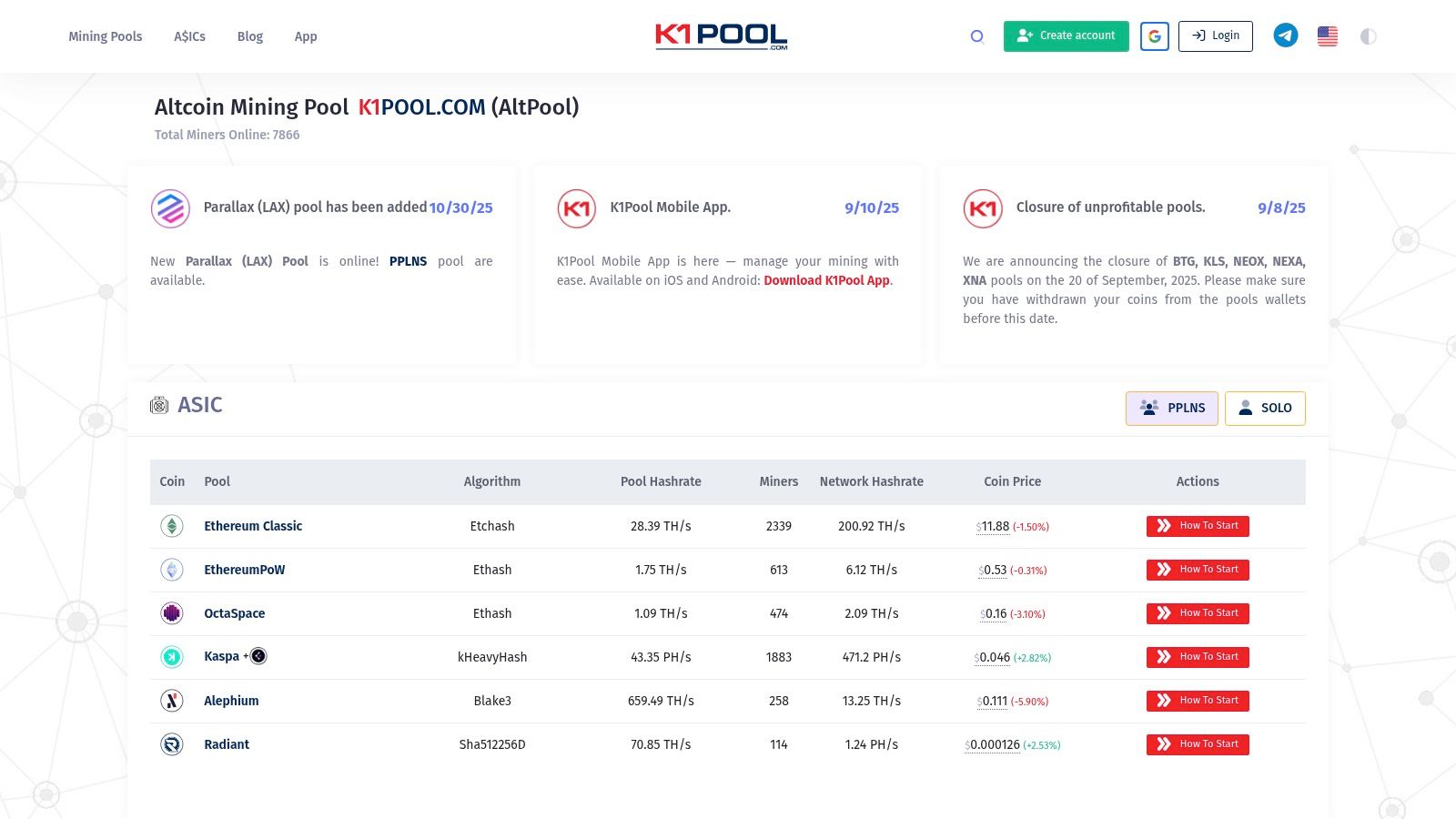
Unlike Bitcoin-centric solo pools, K1Pool caters to a broader hardware ecosystem. If a miner on one of its SOLO pools finds a block, they receive the full block reward for that specific coin, minus a small pool fee. This model allows miners with mid-range hardware to engage in the high-risk, high-reward game of solo mining on networks with lower difficulty than Bitcoin, making the “lottery” more accessible.
Key Features and User Experience
K1Pool stands out with its user-friendly interface and robust feature set designed for altcoin miners. The dashboard clearly lists each available coin for solo mining, complete with essential statistics like pool hashrate, network hashrate, and current price, empowering miners to make informed decisions.
- Dedicated SOLO Listings: The platform provides a well-organized directory of SOLO pools, making it easy to navigate and select a coin to mine based on its algorithm.
- Extensive Tooling: K1Pool supports its users with a mobile app for monitoring, an API for custom integrations, and a Telegram bot for real-time notifications.
- NiceHash Compatibility: The pool is designed to be friendly to hashrate rental services like NiceHash, providing specific instructions for easy setup.
- Community Support: Active support channels on Telegram and Discord allow miners to connect with peers and get assistance quickly.
Ideal Use Case and Technical Setup
K1Pool is ideal for GPU miners or those with non-SHA256 ASICs who want to try solo mining on altcoin networks. It serves as an excellent testing ground to see if one’s hashrate is sufficient to find a block on a less competitive network. While the fees are not always displayed prominently on the homepage, they are clearly detailed within the “How to Start” documentation for each specific coin.
Configuration Example for a Kaspa (KHeavyHash) Miner:
- URL:
stratum+tcp://eu.k1pool.com:23232 - Worker/Username:
YourKaspaWalletAddress.WorkerName - Password:
x(or any)
Setting up is straightforward, allowing miners to start quickly. However, the inherent risk of solo mining remains: you could mine for an extended period without finding a block and earn nothing.
In summary: K1Pool is an excellent, well-organized platform for miners focused on solo mining altcoins. Its strong community support, mobile app, and clean interface make it a fantastic choice for those looking to explore solo opportunities beyond the major networks.
6. SoloPool.org
SoloPool.org offers a versatile and multi-coin approach to solo mining, positioning itself as a strong contender for the best solo mining pool for miners with diverse hardware. Instead of a single unified platform, it operates as a collection of individual, coin-specific pools, each with its own subdomain (e.g., btc.solopool.org, ltc.solopool.org). This structure caters to both ASIC and GPU miners who wish to solo mine a wide variety of cryptocurrencies, from giants like Bitcoin and Litecoin to altcoins like Kaspa and Monero.
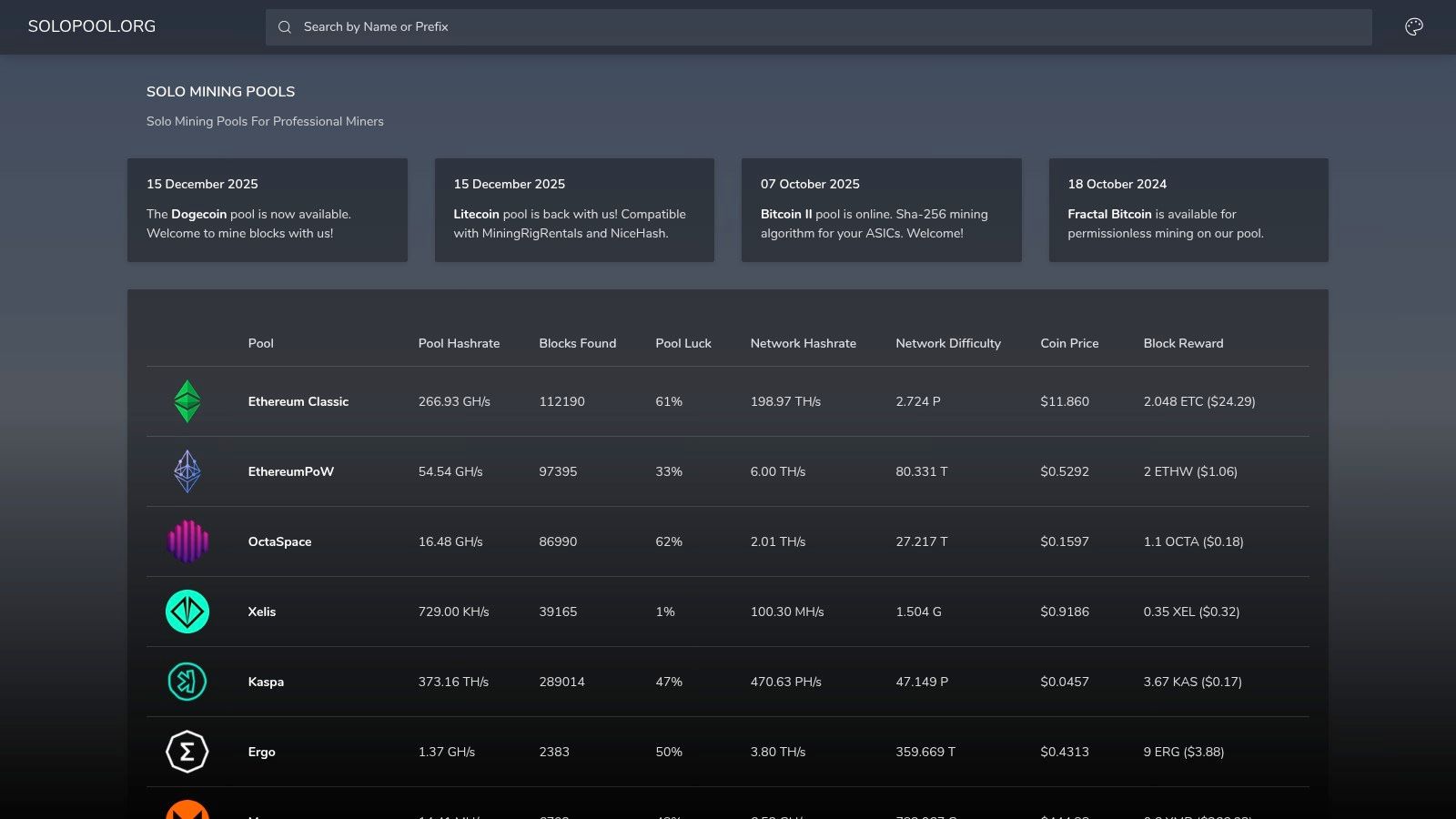
The platform’s model is pure solo mining: you only get paid if your hardware finds a block. When that happens, you receive the full block reward and transaction fees, minus the pool’s fee, which varies depending on the coin. Its broad algorithm support and clear compatibility with hashrate rental services make it a flexible option for those looking to aim for lottery-style payouts across different networks.
Key Features and User Experience
The defining feature of SoloPool.org is its decentralized, multi-coin structure. Each coin has a dedicated, minimalist webpage that provides the essential connection details and basic network statistics. While the user experience is spartan and lacks the polished dashboards of larger pools, its strength lies in its functional simplicity and breadth of choice.
- Wide Coin Support: Offers dedicated solo mining pools for numerous coins across various algorithms like SHA-256 (BTC), Scrypt (LTC/DOGE), kHeavyHash (KAS), and RandomX (XMR).
- Rental Service Compatibility: Many of its pools are explicitly designed to be compatible with NiceHash and MiningRigRentals, providing the stability needed for high-share submissions.
- Regional Endpoints: For popular coins, it offers selectable US and EU stratum servers to help miners optimize their connection and reduce latency.
- Pure Solo Payouts: Adheres to a strict solo model (SOLO/PPLNS), where the block finder receives the entire reward minus a pool fee.
Ideal Use Case and Technical Setup
SoloPool.org is ideal for the experienced miner who operates various types of hardware (ASICs and GPUs) and wants to dedicate them to solo mining different coins simultaneously. It’s also an excellent choice for those renting hashrate to target a specific network. The setup process is consistent across all its sub-pools, requiring only the correct stratum URL and your wallet address. New miners can find comprehensive guides explaining how to start; this guide on Bitcoin mining for beginners is a good starting point for understanding the fundamentals.
Configuration Example for a Kaspa (KAS) Miner:
- URL:
stratum+tcp://kas.solopool.org:8008 - Worker/Username:
YourKaspaWalletAddress.WorkerName - Password:
x
A significant drawback is that policies and fees are not centralized. You must visit each specific coin’s subdomain to verify the fee (typically 1-2%) and available stratum servers.
In summary: SoloPool.org is a highly flexible, if barebones, option for experienced miners. Its strength is the sheer number of coins available for solo mining, making it a great choice for users who prioritize variety and simplicity over a polished interface.
Top Solo Mining Pools: A Comparative Overview
Choosing the right solo mining pool depends heavily on your specific needs, from the coins you want to mine to the level of privacy you desire. This table breaks down our top picks to help you compare them at a glance.
| Pool Name | Best For | Key Differentiator | Fee (Typical) | Registration Required? |
|---|---|---|---|---|
| Solo CKPool | Anonymity & Simplicity (BTC) | No-account, privacy-first Bitcoin solo mining | 2% | No |
| ViaBTC | Flexibility & Professional Tools | Switch between SOLO, PPS+, PPLNS; enterprise features | 1-4% | Yes |
| 2Miners Solo | Altcoin Variety & User Experience | Polished interface and broad support for GPU coins | 1.5% | No |
| WoolyPooly | Low Fees & Emerging Coins | Competitive fees and options for newer altcoins | 1% | No |
| K1Pool | Organized Altcoin Mining & Community | Structured SOLO listings and strong community support | Varies | No |
| SoloPool.org | Broadest Coin Support | A collection of minimalist, single-coin solo pools | 1-2% | No |
Final Verdict: Is the Solo Mining Gamble Worth the Risk?
Navigating the world of solo crypto mining is less about finding a steady income stream and more about strategically buying a lottery ticket with a calculated, albeit low, probability of a massive payout. Throughout this analysis, we have dissected the leading platforms that facilitate this high-stakes endeavor. The central question remains: after weighing the immense potential rewards against the significant risks and prolonged variance, is the solo mining gamble a worthwhile venture for you?
The answer is not a simple yes or no; it is a nuanced decision entirely dependent on your hashrate, risk tolerance, and long-term strategy. The journey to finding the best solo mining pool for your operation begins with an honest assessment of these factors.
Recapping the Key Takeaways
Our deep dive into the top solo-capable pools has revealed several critical themes that should guide your choice. Let’s consolidate the most important insights:
- Hashrate is King: The single most significant determinant of solo mining success is your share of the total network hashrate. Miners with substantial ASIC farms have a statistical advantage, shortening the time-to-block. For GPU miners, targeting lower-difficulty altcoins is the only mathematically viable path.
- Fees and Payouts Matter: While the dream is to keep 100% of the block reward, pool fees (often 1-2%) are a reality. More importantly, understanding the payout threshold and schedule is crucial for managing your operational cash flow.
- Infrastructure is Non-Negotiable: A pool’s reliability, server latency, and uptime are paramount. A pool that is frequently down or has high latency to your location effectively reduces your hashrate and your chances of finding a block. Pools like Solo CKPool and 2Miners are often praised for their robust and stable infrastructure.
- Data-Driven Decisions are Essential: Relying on gut feelings is a recipe for failure. Tools like MiningPoolStats are indispensable for monitoring real-time network difficulty, pool hashrates, and historical block data. This data helps you set realistic expectations and pivot your strategy when network conditions change.
A Framework for Your Decision
To move from analysis to action, consider this framework when selecting the best solo mining pool for your specific situation. This isn’t about which pool is objectively “best,” but which is the right fit for you.
Assess Your Scale:
- Large-Scale ASIC Operations: Your primary focus should be on pools with proven stability, minimal fees, and low-latency servers. Solo CKPool and the solo option at ViaBTC are built for this scale, offering the raw performance you need.
- Mid-to-Small Scale GPU/ASIC Miners: Your strategy should pivot towards pools that support a wide range of altcoins where your hashrate can be more impactful. 2Miners Solo, WoolyPooly, and K1Pool offer this flexibility, allowing you to “hunt” for blocks on less competitive networks.
Evaluate Your Risk Tolerance:
- High Tolerance / Long-Term Horizon: If you can sustain operations for months or even years without a payout, you can afford to aim for the biggest jackpots on high-difficulty networks.
- Moderate Tolerance / Need for Some Cash Flow: Consider a hybrid approach. Allocate a portion of your hashrate to a solo pool while keeping the rest on a traditional PPLNS pool. This strategy provides a stable income floor while still giving you a shot at the solo prize.
Prioritize Your Features:
- For Simplicity and Reputation: Solo CKPool and 2Miners Solo are leaders for a reason. They offer a straightforward, reliable experience.
- For Coin Diversity: WoolyPooly and K1Pool are unmatched in their support for a vast array of mineable coins, perfect for the exploratory miner.
- For Anonymity: If privacy is a key concern, pools like Solo CKPool and SoloPool.org that require no registration offer a distinct advantage.
Solo mining is the ultimate expression of decentralization and a testament to the probabilistic heart of cryptocurrency. It is a challenging, often frustrating, but potentially life-changing pursuit. By arming yourself with the right data, choosing a pool that aligns with your hardware and strategy, and maintaining a healthy dose of patience, you position yourself to take a credible shot at the block reward. The odds are long, but for the well-prepared miner, the jackpot is very real.
Frequently Asked Questions (FAQ)
1. What is the difference between solo mining and pool mining?
Pool mining involves thousands of miners combining their hashrate to find blocks more frequently. The block reward is then split among all participants based on their contribution. Solo mining is when you attempt to find a block by yourself. You get to keep the entire block reward if you succeed, but your chances of finding a block are much lower, leading to highly infrequent and unpredictable payouts.
2. Is solo mining profitable in 2026?
Profitability is not guaranteed and depends entirely on luck, your hashrate, and the network difficulty of the coin you’re mining. For most small miners, solo mining Bitcoin is not profitable due to the immense network hashrate. However, solo mining less competitive altcoins with a powerful GPU or ASIC can be profitable if you are lucky enough to find a block. It’s best viewed as a high-risk, high-reward gamble rather than a steady source of income.
3. Can I solo mine Bitcoin with a single ASIC?
Technically, yes, you can connect a single ASIC to a solo mining pool. However, the probability of a single modern ASIC finding a Bitcoin block is astronomically low. It could take many years, or even decades, to find one. For this reason, solo mining Bitcoin is generally only considered viable for miners with very large operations (hundreds or thousands of ASICs).
4. What is the best crypto for solo mining?
The best crypto for solo mining is typically one with a lower network hashrate and difficulty, where your personal hashrate can represent a more significant portion of the total. This increases your statistical chances of finding a block. Coins like Ethereum Classic (ETC), Ravencoin (RVN), or newer, less-established cryptocurrencies are often popular choices for solo miners with GPUs or specific ASICs. Always use a tool like MiningPoolStats to research a coin’s network difficulty before starting.
5. Do I need an account to join a solo mining pool?
It depends on the pool. Pools like Solo CKPool, 2Miners, and WoolyPooly are designed for anonymity and do not require registration. You simply configure your mining software with the pool’s stratum address and your wallet address. Other more feature-rich platforms like ViaBTC require you to create an account to access their dashboard, switch between mining modes, and use advanced monitoring tools.