GPU Mining Profitability
Yes, GPU mining is still profitable, but the game has completely changed. Gone are the gold rush days where you could plug in a powerful card and almost guarantee a profit. Today’s mining world is more like deep-sea fishing than panning for gold—it demands the right gear, knowing where the fish are biting, and a razor-sharp focus on your operational costs.
Is GPU Mining Still a Profitable Venture
The story of GPU mining has taken a sharp turn. While the era of minting Ethereum in your dorm room to pay for tuition is a memory, new doors have opened, especially in the vast world of altcoins. The fundamental challenge, however, hasn’t changed one bit: the money you make from mined coins has to consistently outweigh your expenses, with electricity being the biggest monster of them all.
This creates a constant tightrope walk. A sudden price surge in an obscure coin can transform a money-losing rig into a cash-printing machine overnight. But just as quickly, a spike in your local energy rates or a flood of new miners joining the network can wipe out those profits.
The Modern Miner’s Reality
The successful miner of today is less of a gambler and more of an analyst. The focus is now squarely on efficiency, adaptability, and meticulous planning. It’s not just about raw horsepower anymore; it’s about mastering the variables that control your bottom line. This means you need to get a handle on a few key areas:
- Strategic Coin Selection: Zeroing in on lesser-known, ASIC-resistant altcoins where your GPU still gives you a fighting chance against specialized hardware.
- Cost Management: Locking down cheap electricity is, without a doubt, the most critical factor that separates profitable operations from expensive hobbies.
- Hardware Efficiency: Picking GPUs based on their performance-per-watt, not just their peak hashrate. An efficient card is a profitable card.
- Market Awareness: Keeping a close watch on everything from network upgrades and algorithm changes to sudden shifts in coin prices.
The question isn’t “Can you make money with GPUs?” anymore. It’s “Can you run your operation more efficiently than the next person?” Profitability has become a direct measure of your operational skill.
To summarize, the modern GPU miner must be an active manager, not a passive one. Success hinges on strategic choices, relentless cost control, and staying informed about the market. Let’s dig into the specific factors that determine your financial results.
Core Factors That Determine Your Profit or Loss
Every miner is constantly juggling a set of key variables. Getting the balance right means staying in the green; getting it wrong means you’re just heating your room for no reason. This table breaks down the essentials you’ll need to master.
| Factor | Impact on Profitability | Key Consideration |
|---|---|---|
| Hashrate | Directly increases potential earnings | Think of this as the “engine power” of your GPU. More hashes, more chances to earn. |
| Electricity Cost | The single largest operational expense; a constant drain | A rate below $0.10/kWh is often the benchmark for being competitive. |
| Coin Price | Determines the market value of your mined assets | This is the wild card. It’s highly volatile and can make or break your month. |
| Network Difficulty | Represents the level of competition for rewards | As more miners join, difficulty rises, and your slice of the reward pie gets smaller. |
In short, your profit is a battle between what you can control (hashrate) and what you can’t (coin price and difficulty), all while being drained by your biggest cost (electricity). Understanding these factors is the first step. The next is learning how to calculate their combined impact on your actual, real-world earnings.
Cracking the GPU Mining Profitability Code
Figuring out if a mining operation will actually make money isn’t some dark art. It’s a simple formula, but one with a few crucial, constantly shifting parts. Each piece of the puzzle matters, and getting a feel for how they all interact is what separates a profitable miner from someone just burning electricity.
Think of it like running any small business. You have your revenue, your fixed costs, and your variable costs. Once you get a handle on this equation, you stop guessing and start making smart, data-backed decisions.
Let’s break down exactly what goes into this all-important calculation.
Your Rig’s Power and Its Thirst for Energy
The first two factors are entirely within your control. They are the foundation of your operation—your raw potential versus your biggest recurring expense.
Hashrate (Your Engine): This is the brute force of your GPU, plain and simple. It’s a measure of how many “guesses” your card can make per second trying to solve the cryptographic puzzle for a new block. A higher hashrate is like having a bigger engine; it gets more work done, which directly boosts your shot at earning rewards. An NVIDIA RTX 4090, for instance, has a completely different level of horsepower than an older RTX 3070.
Power Consumption (Your Fuel Bill): Every single one of those hashes costs electricity. This is your most persistent, non-negotiable expense, measured in watts (W). A card pulling 300W will cost exactly twice as much to run per hour as one drawing 150W, assuming your electricity price is the same. Getting this number as low as possible is critical for long-term survival.
The Wild Cards: Market and Network Forces
Now for the parts you can’t control. These external factors are what make mining so dynamic, determining both how much competition you face and what your hard-earned coins are actually worth.
Network Difficulty
Imagine you and a few friends are trying to solve a Sudoku puzzle for a prize. Your odds are pretty good. Now, imagine a stadium full of people all working on the same puzzle. Suddenly, your individual chance of solving it first plummets.
That’s network difficulty in a nutshell. It’s an automatic adjustment mechanism built into a cryptocurrency’s code to keep blocks being found at a predictable pace. As more miners (and more hashrate) join the network, the difficulty ratchets up, making the puzzle harder. This means your GPU, with its fixed hashrate, will earn you less and less of that coin over time if the network keeps growing.
Coin Price and Block Rewards
Together, these two variables dictate your gross income—the total value you pull in before a single cost is deducted.
- Block Reward: This is the set amount of new coins created and paid out to the miner or pool that finds the next block. A network might, for example, issue 50 new coins for every valid block discovered.
- Coin Price: This is the simple market value of the coin you’re mining. Earning 50 coins worth $1 each is a world away from earning 50 coins worth $100 each. This is easily the most volatile piece of the entire profitability puzzle.
The Bottom Line: Your gross revenue is basically (Your Share of the Total Network Hashrate) × (Block Reward) × (Coin Price). Your hashrate stays the same, but the other factors can swing wildly, making your daily income just as unpredictable.
Finally, we have the small price of not going it alone.
Mining Pool Fees
Unless you’re running a warehouse-sized operation, you’ll be joining a mining pool. Pools let you combine your hashrate with thousands of other miners, which smooths out your earnings from a lottery-ticket chance to a small, steady trickle. For providing this service, the pool takes a cut, usually between 1% and 3% of your earnings.
To wrap it up, your profitability hinges on six key variables: hashrate, power cost, network difficulty, block rewards, coin price, and pool fees. With this complete picture, you have the formula for GPU mining profitability. Now, it’s time to plug in your numbers and see what they tell you.
How to Calculate Your Potential Mining Profits
So, you understand the key factors that swing mining profitability from boom to bust. That’s the theory. Now it’s time to roll up our sleeves and turn those concepts into a real financial forecast for your own hardware. This is where you move from educated guessing to making a solid, data-driven decision.
The math itself isn’t rocket science. At its heart, the formula is beautifully simple:
Gross Revenue (from mined coins) – Operating Costs (mainly electricity) = Net Profit
You could track everything and run these numbers yourself, but the crypto market moves at lightning speed. Network difficulty can spike overnight and coin prices can tank in a matter of hours, making any manual calculation stale almost as soon as you finish it. This is why specialized tools are no longer a luxury—they’re essential.
Using Profitability Calculators
The smartest and fastest way to get a live, accurate estimate of what you could earn is to use an online GPU mining profitability calculator. These tools are indispensable. They do all the heavy lifting by constantly pulling in the latest data on coin prices, network difficulties, and block rewards.
One of the most trusted names in the space is WhatToMine. It’s the go-to for many miners. You just plug in your specific graphics cards, your hashrates, and what you pay for electricity, and it spits out a real-time ranking of the most profitable coins to mine right now. For a closer look at how these calculations work behind the scenes, you can play around with our own detailed crypto mining profitability calculator to see how tweaking different inputs changes the final numbers.
Here’s a glimpse of the WhatToMine interface. You can see how easy it is to select your GPUs and get instant feedback.
This dashboard is where the magic happens. You enter how many of each GPU you have, and it automatically fills in the estimated hashrates for different algorithms. The real power here is in its simplicity; with just your hardware and power cost, you get an immediate, ranked list of what to mine for the best returns.
A Step-by-Step Calculation Example
Let’s ground all this in reality with a quick, hypothetical daily profit calculation for a single, popular GPU. This will make it crystal clear how each variable chips away at your revenue to leave you with your final profit. To illustrate how these numbers come together, let’s break down a hypothetical scenario for a common mid-range GPU.
Sample Profitability Calculation for a Single GPU
| Metric | Value | Notes |
|---|---|---|
| GPU Model | NVIDIA GeForce RTX 3070 | A common mid-range card. |
| Algorithm | KawPoW (Ravencoin) | A popular choice for GPUs. |
| Hashrate | ~25 MH/s | Typical performance on this algorithm. |
| Power Consumption | 225W (0.225 kW) | A standard power draw for this card while mining. |
| Electricity Rate | $0.10 per kWh | A competitive rate, but varies wildly by location. |
| Pool Fee | 1% | A standard fee for most mining pools. |
| Daily Revenue (Pre-Costs) | ~$0.36 | This value fluctuates constantly with coin price and difficulty. |
This table sets the stage, but the real story unfolds when you connect the dots and see how quickly your potential earnings get eaten up by costs.
Now, let’s run the numbers based on that table:
- Calculate Daily Electricity Cost: This is your biggest and most relentless expense.
- 0.225 kW (Power) × 24 hours = 5.4 kWh consumed per day.
- 5.4 kWh × $0.10/kWh = $0.27 per day.
- Calculate Gross Daily Profit: This is your revenue minus that power bill.
- $0.36 (Revenue) – $0.27 (Electricity) = $0.09 per day.
- Factor in Pool Fees: Don’t forget, the pool takes a small slice for their services.
- $0.09 × 1% (0.01) = $0.0009.
- $0.09 – $0.0009 = ~$0.089 Net Daily Profit.
This simple exercise reveals a hard truth about modern GPU mining: the margins are razor-thin. A small hike in your power rates or a slight dip in a coin’s price could easily push this operation from a tiny profit into a daily loss.
The gap between different tiers of GPUs is also massive. Recent data from Hashrate.no shows just how critical hardware selection has become. For instance, a top-of-the-line NVIDIA RTX 4090 can pull in about $3.05 in daily revenue (before power costs). After paying for its electricity at $0.10 per kWh, its net profit is still a respectable $2.50 per day.
Contrast that with the RTX 3070 from our example. It starts with just $0.36 in daily revenue, and after its $0.27 power cost, the profit dwindles to a mere $0.09 per day. This stark difference highlights that having efficient, top-tier hardware and cheap power isn’t just an advantage anymore—it’s practically a requirement to stay in the game. By using these tools and running the numbers yourself, you can get a clear-eyed view of your potential before you spend a dime.
Choosing the Right Coins and Mining Pools
Figuring out your potential profit is just the starting line. To actually maximize that profit, you need to make some smart decisions. The choices you make about what to mine and where to mine it are what separate a serious operation from an expensive hobby. This is where you stop being just a hardware owner and start acting like a strategic market participant.
Think of it like investing. Do you play it safe with the “blue-chip” coins that have massive networks and fierce competition? Or do you take a calculated risk on a newer altcoin that has the potential for explosive growth? There’s no single right answer, but each path comes with a very different risk-to-reward ratio.
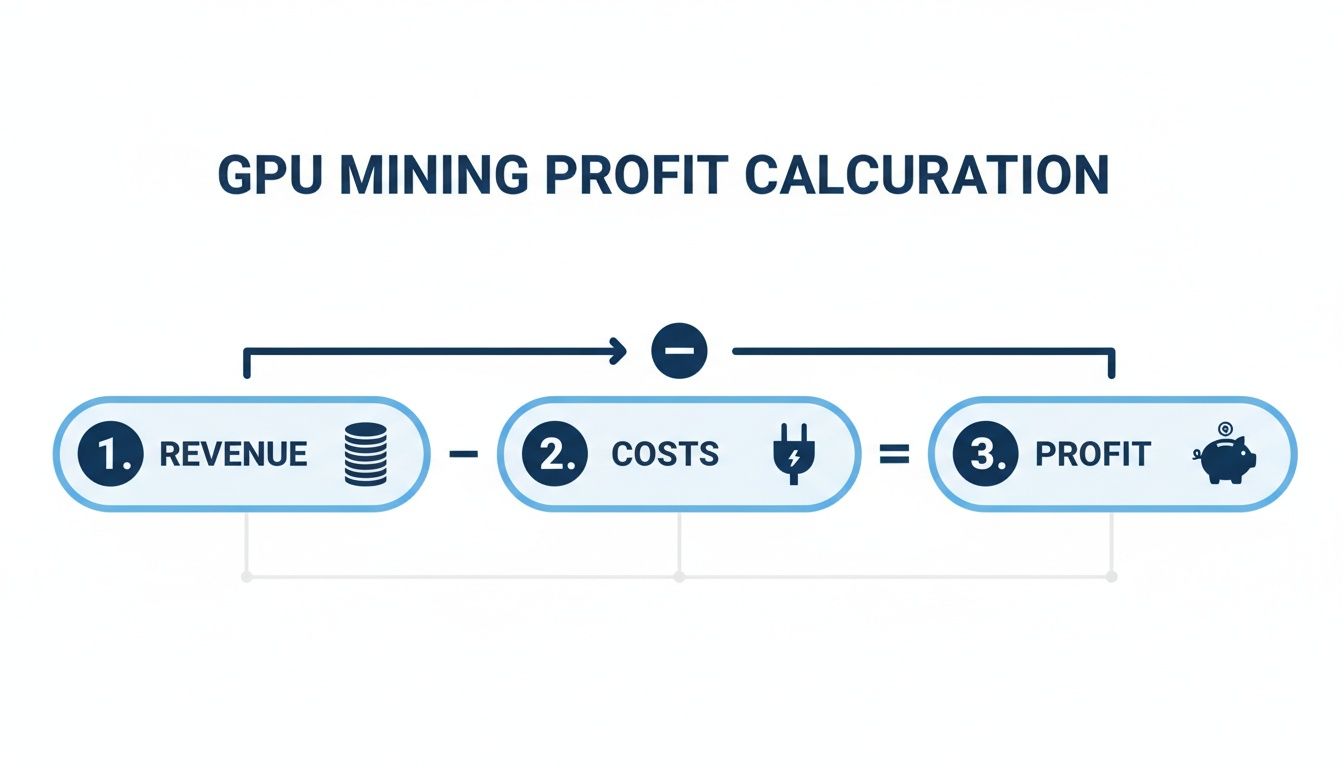
This diagram breaks it down beautifully: your profit is simply what’s left over after you subtract operational costs—mostly electricity—from the revenue your rig generates.
Selecting the Best Coin for Your GPU
The coin you decide to mine is arguably the single most important factor for your rig’s profitability. The best coin for an NVIDIA RTX 4090 might be a terrible choice for an AMD RX 7900 XT, all because of how their internal architectures are designed.
Here’s a simple framework for zeroing in on the right coin:
- Algorithm Compatibility: Every GPU is built to crush certain cryptographic algorithms while being just average at others. You need to know what your specific card is good at. A GPU might be a monster on the KawPoW algorithm but a slouch on Autolykos2. Do your homework.
- Current Profitability: Use real-time data from online profitability calculators. These tools are indispensable, constantly crunching current coin prices and network difficulties to show you which coin will make you the most money right now.
- Future Potential: Don’t get tunnel vision chasing today’s top earner. Step back and consider a coin’s long-term prospects. Is there an active development team? A passionate community? A real-world use case? Mining a less profitable coin that doubles in value later can be far more lucrative than mining a top earner that goes nowhere.
The real magic of GPU mining is its flexibility. Unlike an ASIC that’s forever locked to one algorithm, you can pivot your GPUs to chase profit wherever it emerges. Mastering this adaptability is a key skill for any serious miner.
For a closer look at what’s hot right now, our guide on the most profitable crypto to mine provides regularly updated insights to help you stay ahead of the curve.
Finding the Right Mining Pool
Once you’ve picked a coin, you need to join a mining pool. For pretty much any GPU miner, going solo and trying to find a block is like playing the lottery; it’s technically possible, but the odds are astronomically against you. Pools solve this by combining the hashrate of thousands of miners to find blocks consistently, then splitting the rewards among everyone.
Choosing the right pool is crucial for a stable, predictable income. Here’s what you should be looking for:
- Low Fees: Pool fees usually hover between 0.5% to 2%. It might not sound like a big difference, but over months and years, it really adds up.
- Payout Scheme: This is how the pool pays you. The two most common methods are PPLNS (Pay Per Last N Shares) and PPS (Pay Per Share).
- Minimum Payout Threshold: Some pools make you wait until you’ve mined a certain amount before they send the coins to your wallet. A lower threshold is almost always better because it means you get your earnings in your hands faster.
- Server Location and Reliability: Pick a pool with servers located physically close to you. This reduces latency, which cuts down on “stale shares” (work that gets rejected). And, of course, make sure the pool has high uptime. A pool that’s constantly down isn’t earning you a dime.
Comparing Pool Payout Structures
The payout model a pool uses has a direct impact on the consistency of your earnings. Understanding the difference is key to matching a pool to your own personal risk tolerance.
| Payout Model | How It Works | Best For Miners Who… |
|---|---|---|
| PPS (Pay Per Share) | You receive a fixed payment for each valid share you contribute, whether the pool finds a block or not. | …prioritize stable, predictable daily income and want to eliminate the risk of mining “bad luck.” |
| PPLNS (Pay Per Last N Shares) | You are paid based on your contribution to the last ‘N’ shares submitted after the pool successfully finds a block. | …are willing to accept some short-term volatility for potentially higher rewards over the long haul. |
In the end, maximizing your GPU mining profit comes down to solid research and smart alignment. You have to match the right coin to your hardware’s unique strengths and the right pool to your financial goals and risk appetite. By carefully weighing these factors, you can build a far more resilient and profitable mining operation.
Squeezing More Profit From Your Mining Rig
Getting your rig built and hashing is just the starting line. The real work—and the real edge—comes from fine-tuning your operation. This is where the pros separate themselves, moving beyond stock settings to extract every last bit of performance from their hardware.
The game is all about finding the sweet spot between raw hashing power and electricity consumption. It’s tempting to crank everything to the max, but that often leads to a sky-high power bill that eats right through your earnings. True optimization is a delicate balancing act.
The Fine Art of Overclocking and Undervolting
Think of your GPU like a race car engine. Overclocking is flooring the gas pedal for more speed (hashrate). Undervolting is like tuning that engine to burn less fuel (power) while maintaining that speed. The magic for GPU mining profitability lies in doing both at the same time.
- Overclocking: This usually means pushing your GPU’s memory clock speed higher. For most mining algorithms, memory performance is far more important than the core clock, so even a small bump can give you a noticeable boost in hashrate.
- Undervolting: This is where you carefully reduce the voltage going to the GPU core. Less voltage means less power drawn from the wall and, crucially, less heat. That’s a double win for your operational costs and the long-term health of your cards.
When you get the combination right, you can hit a higher hashrate while drawing 10-30% less power. That efficiency gain is where you’ll find sustained, long-term profit. If you’re still in the planning phase, our guide on building a GPU mining rig covers the hardware fundamentals you’ll need before you can start tuning.
Keeping Things Cool and Stable
Heat is the number one enemy of a mining operation. If a GPU gets too hot, it will automatically slow down—or “throttle”—to protect itself. This kills your hashrate and, by extension, your profits. Over time, running hot will also drastically reduce the lifespan of your expensive hardware.
Keeping your temperatures in check isn’t optional; it’s essential.
- Keep It Clean: Dust is a great insulator, which is exactly what you don’t want. A regular cleaning with compressed air to clear out dust from fans and heatsinks is one of the simplest yet most effective things you can do.
- Think About Airflow: Make sure your rig has room to breathe. Arrange your fans to create a consistent flow of cool air coming in and hot air going out. Don’t crowd your GPUs together.
- Watch Your Temps: Your mining software is your best friend here. Keep a close eye on your GPU temperatures and aim to keep them safely below 70°C (158°F) for stable, long-term operation.
An optimized rig isn’t just about raw speed; it’s about endurance. A stable, cool-running machine that avoids downtime will consistently outperform a faster, hotter rig that crashes frequently.
Ultimately, optimizing your rig is a continuous process. It’s about making small, incremental adjustments to find what works best for your specific cards and environment. Mastering the relationship between clocks, voltage, and temperature is what turns your hardware from a simple machine into a lean, profit-generating engine.
The Wild Ride of GPU Mining
If you want to understand what makes GPU mining tick today, you have to look back at its rollercoaster history. The whole industry is a story of epic boom-and-bust cycles, a place where fortunes have been made—and lost—in the blink of an eye. This history isn’t just trivia; it’s crucial for setting realistic expectations and figuring out how to play the game now.
The biggest chapter in that story, without a doubt, was Ethereum. For years, it was the undisputed king, the single driving force behind GPU mining. Then came “The Merge” in 2022, when it switched from Proof-of-Work (PoW) to Proof-of-Stake (PoS). It was a seismic shift. Suddenly, millions of GPUs that were printing money had nothing to do, flooding the market and tanking profits for just about everyone.
The Great Divide: ASICs vs. GPUs
That event really threw a spotlight on the fundamental split in the crypto mining world. When it comes to the big players like Bitcoin, the profitability war was over long ago. ASICs (Application-Specific Integrated Circuits) won, hands down. These are hyper-specialized machines designed for a single task: mining one specific algorithm with brutal efficiency. A modern ASIC can out-mine any GPU on Bitcoin by thousands of times over, making it a fool’s errand to even try.
This has effectively pushed GPUs into their own corner of the ring. They’ve become the tool of choice for a new wave of altcoins built with ASIC-resistance in mind. These coins use algorithms that rely heavily on memory, a feature that general-purpose hardware like GPUs excel at, which helps level the playing field.
Here’s the bottom line: a GPU’s superpower is its flexibility. An ASIC is a one-trick pony, locked into a single coin. A GPU, on the other hand, can switch between hundreds of different coins, allowing miners to chase profitability wherever it pops up. This adaptability is the key to survival.
This constant cat-and-mouse game creates a very fluid environment. The period from 2016 to 2021 was one of the most extreme cycles we’ve seen, largely supercharged by Ethereum’s bull run. The subsequent collapse turned a lot of rigs into expensive paperweights overnight, especially for anyone paying more than $0.10–$0.12/kWh for electricity. We saw bankruptcies, massive hardware sell-offs, and a flooded secondhand market where some GPUs lost over 50% of their value. You can find a more detailed breakdown of this era on Wikipedia’s page for GPU mining history.
Frequently Asked Questions
Diving into GPU mining always brings up a few key questions, especially when you’re just starting out. Let’s tackle some of the most common ones that pop up for both new and seasoned miners.
What’s the Bare Minimum Hardware to Start Mining?
Technically, you can get started with a single modern gaming GPU—think something like an NVIDIA RTX 3060 or newer. But let’s be realistic: turning a real profit at that scale is a tough uphill battle.
The most important spec to watch for as a beginner is VRAM. You’ll need a card with at least 6-8GB of VRAM to handle many of the popular mining algorithms out there today.
Ultimately, though, your success won’t just come down to the hardware. It’s more about your electricity cost and picking the right coin at the right time. If you’re serious about generating income, you’ll almost certainly need a dedicated rig with multiple GPUs to get enough hashrate to outpace your operational costs.
How Do I Handle Taxes on Mining Profits?
This is a big one, and the rules can be a minefield because they change drastically from country to country. Your first step should always be to talk to a local tax professional.
Generally speaking, most tax authorities treat mined crypto as income. You calculate its value based on the coin’s market price on the exact day it hits your wallet.
Then, down the road, if you sell or trade that crypto and it’s gone up in value, you’ll likely owe capital gains tax on the profit. This is why meticulous record-keeping is crucial. You have to track your rewards, power costs, and all the dates to stay on the right side of the law.
Can I Still Mine Bitcoin with a GPU?
The short answer is no. It’s just not profitable to mine Bitcoin directly with a GPU anymore. The Bitcoin network’s difficulty has skyrocketed to a point where you need incredibly powerful, specialized hardware called ASICs (Application-Specific Integrated Circuits).
Back in the early days, GPUs were the way to go. But today’s ASICs are built to do one thing—mine Bitcoin—and they’re thousands of times more efficient at it. Trying to compete with a GPU is a guaranteed money-loser.
What Should I Do If My Mined Coin Becomes Unprofitable?
Welcome to the daily life of a GPU miner! This happens all the time. The biggest edge you have with a GPU is its flexibility, which is something an ASIC just can’t offer. While an ASIC is stuck on one algorithm for life, your GPU can pivot to hundreds of other coins.
When your current coin takes a nosedive in profitability, your first move should be to fire up a calculator like WhatToMine to find the next best option for your hardware. Staying agile and being ready to switch coins is the core strategy for maintaining long-term GPU mining profitability. That adaptability is your most valuable asset.