Mining GPU Profitability
So, is GPU mining still a profitable game? The short answer is yes, but it’s a completely different beast than it was during the gold rush days. Today, profitability isn’t about brute force; it’s about strategic efficiency. It all comes down to a careful balancing act between cheap electricity, the right hardware, and knowing which coin to point your rig at.
In short, success in modern GPU mining is less about raw power and more about smart, calculated decisions.
Decoding Profitability in Today’s Mining Landscape
Simply buying the beefiest graphics card off the shelf no longer guarantees a return. Modern GPU mining demands a solid grasp of several moving parts that directly impact your bottom line. The old “set it and forget it” mentality is a recipe for losing money; today’s miners have to be active, informed strategists.
The best way to think about mining GPU profitability is to treat it like a small business. Your GPU is the key asset, and its operating costs (mostly power) have to be constantly measured against the revenue it generates. This constant push and pull is the very heart of a successful mining operation.
The Core Variables You Must Master
Your potential earnings are dictated by a handful of make-or-break factors. If you overlook even one, you risk turning a potentially profitable rig into a very expensive space heater. For anyone serious about this, getting these variables right is non-negotiable.
Here are the critical factors you need to monitor:
- Hardware Efficiency (Hashrate vs. Power): This is the big one. It’s not just about how fast your GPU hashes, but how much power it sucks from the wall to get there. The holy grail is achieving the highest hashrate for the lowest possible power draw.
- Electricity Cost: This is your number one enemy. As the single largest ongoing expense, your local electricity rate can single-handedly decide whether you’re in the black or in the red. A miner with access to cheap power has a massive, almost unfair, advantage.
- Cryptocurrency Choice and Price: The crypto markets are wild. The coin that’s making you money on Tuesday could be worthless by Friday. You have to stay on top of market prices and be ready to switch what you’re mining.
- Network Difficulty: Think of this as the competition. As more miners pile onto a network, it gets harder for everyone to find a block. This naturally squeezes individual rewards over time.
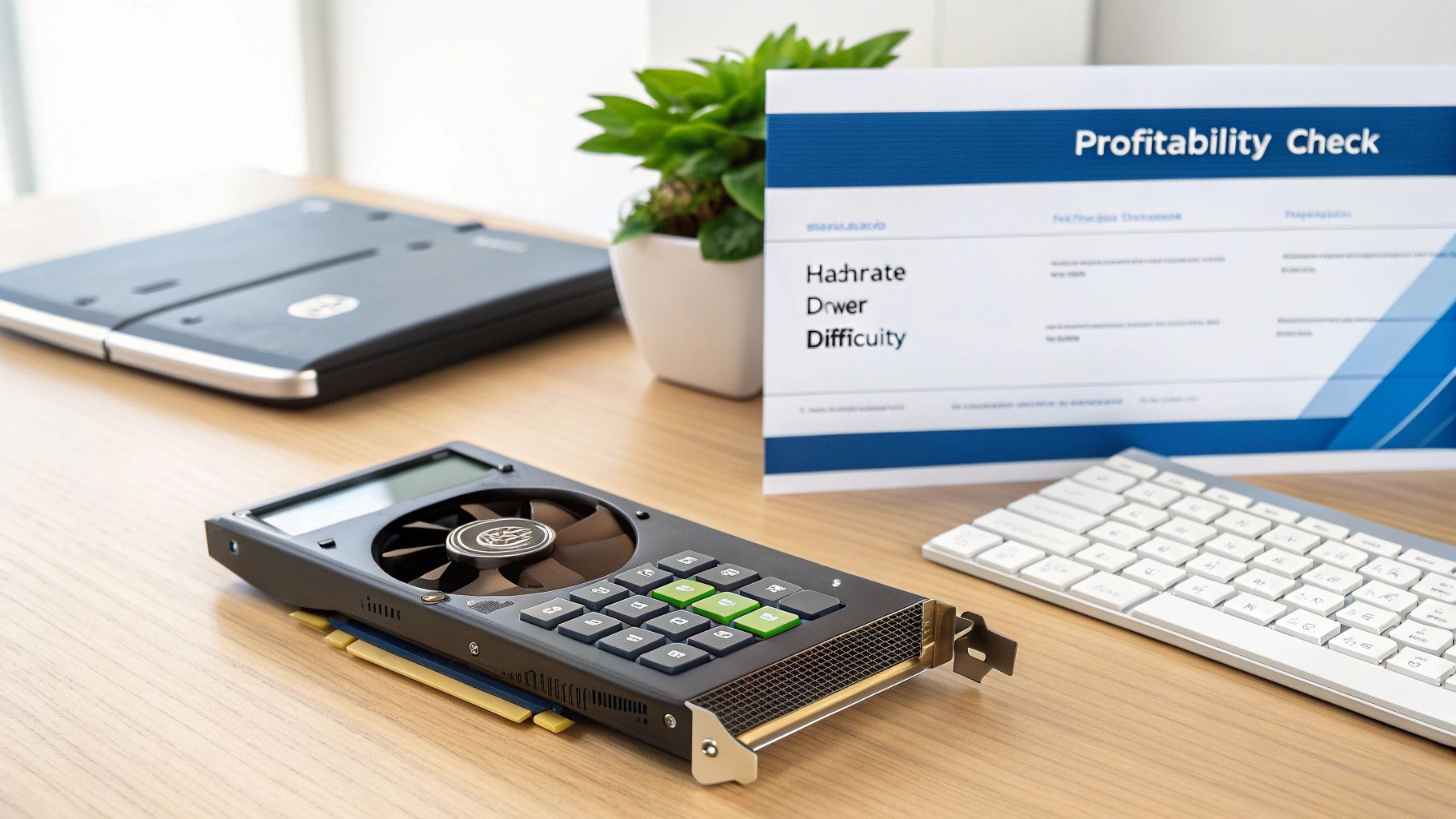
For a real-world gut check, miners constantly turn to tools like WhatToMine, a popular profitability calculator. You punch in your hardware and electricity costs, and it spits out the numbers.
What this data often shows is that even a top-tier GPU might only net a few dollars a day after power costs. It’s a game of inches, and that’s why these calculations are so critical.
To summarize, your profit hinges on the efficiency of your hardware, the cost of your electricity, and the volatile nature of the crypto market. Mastering these variables is the first step toward a successful mining operation. The table below breaks down these factors in more detail.
Key Factors Determining GPU Mining Profitability
This table summarizes the most critical variables that miners must consider to calculate and optimize their potential earnings.
| Factor | Description | Impact on Profitability |
|---|---|---|
| Hashrate | Your GPU’s raw processing power—how fast it can guess solutions to the cryptographic puzzle. | High: More guesses per second means a larger share of the mining rewards. It’s your top-line revenue driver. |
| Power Consumption | How much electricity your hardware consumes to run, measured in watts (W). | High: Directly increases your operating expenses, eating into your profits. Every watt counts. |
| Electricity Cost | The price you pay per kilowatt-hour ($/kWh). This varies wildly by location. | Low: This is the ultimate advantage. Lower power costs create a wider profit margin on every coin you mine. |
| Coin Price | The current market value of the cryptocurrency you’re mining. | High: Directly boosts the fiat value of your rewards. You earn the same number of coins, but they’re worth more. |
| Network Difficulty | An algorithmically adjusted score representing how hard it is to find a block. | High: As competition grows, your slice of the pie gets smaller. It’s a constant headwind against profitability. |
The GPU Mining Profitability Equation
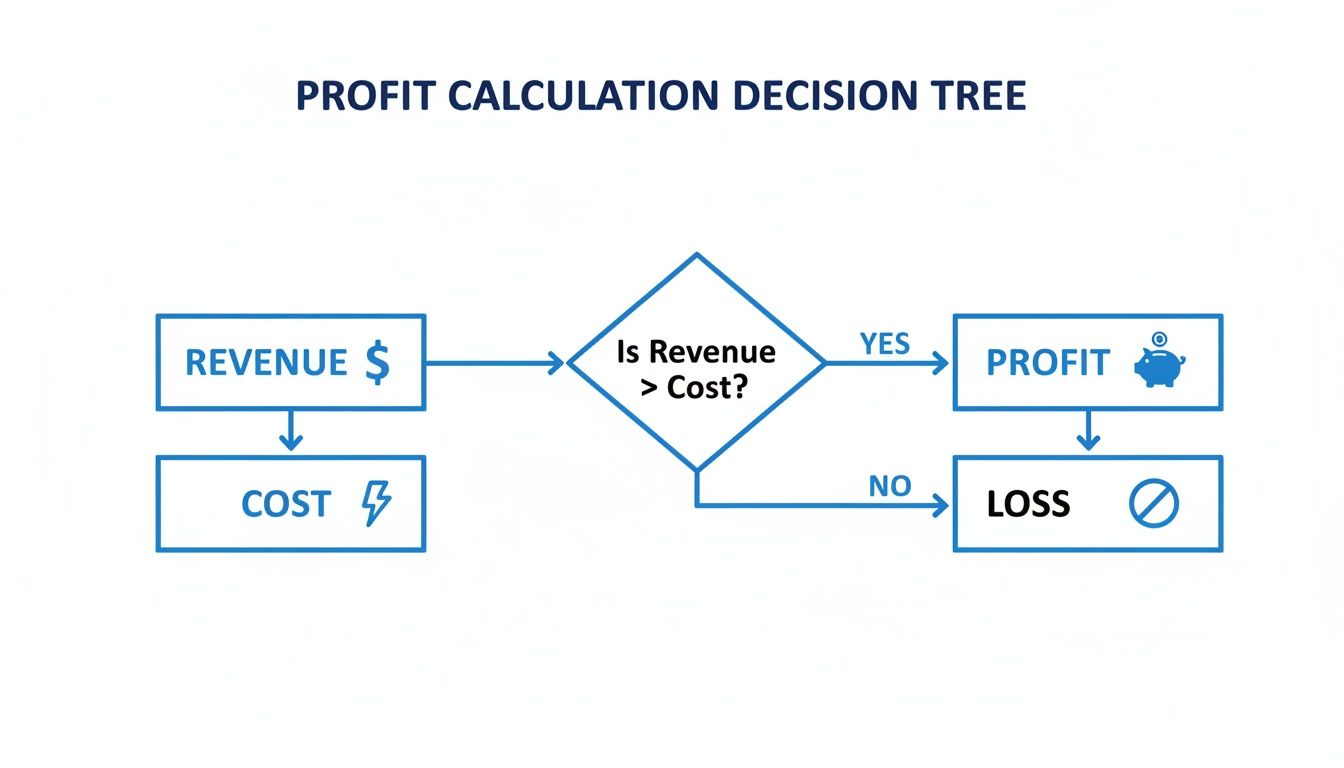
Before you can predict whether a GPU will make you money, you have to learn the language. The entire game really boils down to a simple formula: Revenue – Costs = Profit. The tricky part is that both sides of that equation are a messy, fascinating mix of what your hardware can do and what the market decides to do.
Think of your mining rig like a specialized freelance business. Your GPU is your main tool, and your job is to complete as many “projects” (solving cryptographic puzzles) as you can, as efficiently as possible.
Your Inputs: The Hardware Side of the Equation
Let’s start with what you can actually control. Before you even glance at a crypto price chart, your potential is defined by the physical limits of your gear and how much it costs you to keep the lights on.
Here’s a breakdown of the key hardware metrics:
- Hashrate (Your Raw Horsepower): This is the big one. Hashrate is just a measure of how many guesses your GPU can make per second to solve the puzzle for the next block. A higher hashrate is like having a faster computer—it boosts your chances of getting paid. It’s usually measured in megahashes per second (MH/s) or gigahashes per second (GH/s).
- Power Consumption (Your Utility Bill): Every guess your GPU makes costs electricity. Measured in watts (W), this number tells you exactly how much power your card is pulling from the wall. A beast of a GPU with terrible power efficiency can eat up all your profits before you even see them. It’s the silent killer of many mining operations.
- Electricity Cost (The Price of Power): This is your single biggest recurring expense, hands down. Your local utility company charges you a certain rate per kilowatt-hour ($/kWh). A few cents difference here might not sound like much, but over months of 24/7 operation, it can be the single factor that separates a profitable rig from one that’s losing money.
These three pieces make up your operational cost baseline. The real art of mining is finding the sweet spot between raw hashrate and power consumption.
The Outputs: The Market’s Contribution
Once your hardware is humming along, your actual revenue is completely at the mercy of the wider market. These are the factors you have absolutely no control over, and they can swing wildly with little to no warning.
The Miner’s Dilemma: You can fine-tune your operational efficiency (getting the most hashrate per watt), but you can’t control the market value of your work. The best miners are masters of efficiency who are also prepared for the market’s volatility.
So, what are these external forces? Let’s look at the market variables that dictate your revenue.
- Coin Price (Your Pay Rate): Pretty straightforward—this is the going market rate for the cryptocurrency you’re mining. If the price tanks, so does your real-world profit. It’s the most volatile variable and the main reason profitability can change so drastically overnight.
- Network Difficulty (The Competition): Imagine you’re a freelance writer and suddenly thousands of new writers enter the market. That’s network difficulty. As more miners point their hashrate at a network, the protocol automatically makes the puzzles harder to solve. This means your slice of the pie gets smaller.
- Block Reward (The Project Payout): This is the fixed payment for finding a block. For instance, a network might award 25 brand new coins to whoever solves the puzzle first. This reward is often programmed to get cut in half every few years in events called “halvings,” which have a massive, long-term impact on a miner’s income.
Once you have a solid grasp of these six variables—three you manage, three you react to—you can look at any online profitability calculator and know exactly what’s driving the numbers.
A Real-World Walkthrough: Calculating Your Daily Profit
Alright, you’ve got the key ingredients in mind. Now, let’s put them together and see what your GPU mining operation could actually earn. This isn’t just about plugging numbers into a machine; it’s about understanding the real-world balance between what you make and what you spend.
At its core, the math is simple. Every miner, from a hobbyist with one GPU to a professional with a whole farm, lives by this basic formula:
(Daily Revenue) – (Daily Electricity Cost) = Daily Net Profit
If the number is positive, congratulations—your rig is making money. If it’s negative, you’re basically paying to heat your room.
Let’s Use a Real-World Example
Let’s ground this in reality with a popular modern GPU: the NVIDIA RTX 4080 SUPER. Manually tracking all the variables is a fool’s errand, so we’ll use a profitability calculator as a guide.
Here’s the data we’d need to get started for mining Ravencoin (RVN):
- GPU: NVIDIA RTX 4080 SUPER
- Hashrate (KawPow algorithm): Around 61 MH/s
- Power Consumption: 280 Watts (W)
- Electricity Cost: $0.10 per kilowatt-hour (kWh)
With this info, we can figure out if this setup is worth it.
Step 1: Calculate Your Daily Power Cost
Your power bill is the silent killer of mining profits. Get this number wrong, and your entire operation could be running at a loss without you even realizing it.
Here’s the formula to find your daily cost:
(Your GPU’s Wattage / 1000) x 24 hours x Your $/kWh rate
Let’s plug in the numbers for our RTX 4080 SUPER:
- (280 W / 1000) = 0.28 kW
- 0.28 kW x 24 hours = 6.72 kWh per day
- 6.72 kWh x $0.10/kWh = $0.67 per day in electricity costs
That’s your daily hurdle. You have to earn more than $0.67 just to break even.
Step 2: Figure Out Your Daily Revenue
Now for the fun part: the income. For this, we turn to a tool like WhatToMine. It shows us that an RTX 4080 SUPER hashing away on the KawPow algorithm (for Ravencoin) can hit about 61 MH/s while pulling 280W.
As of early 2025, that kind of performance was generating around $1.26 in daily revenue under ideal conditions. This figure constantly changes with the coin’s price and network difficulty, but it gives us a solid number to work with.
Key Takeaway: Your local electricity rate is the single most important variable you can control. If your rate was $0.15/kWh instead of $0.10, your daily cost would jump to $1.01, wiping out almost all your profit. Know your rate down to the fraction of a cent.
Step 3: Put It All Together for Your Net Profit
Time to bring it all home and see the final number.
- Daily Revenue: $1.26
- Daily Electricity Cost: $0.67
- Daily Net Profit: $1.26 – $0.67 = $0.59
And there you have it. A single RTX 4080 SUPER, under these specific market conditions, would net you just under sixty cents a day. This really drives home how tight the margins can be and why you have to stay on top of your numbers.
Want to run the numbers for your own gear? Use our detailed crypto mining profitability calculator to plug in your specific hardware and electricity rate. Profitability isn’t a “set it and forget it” game—it’s a moving target you need to watch every single day.
Choosing the Right Mining Pool to Maximize Earnings
For most of us, trying to mine crypto on our own—what’s known as solo mining—is a fool’s errand. It’s like buying a single lottery ticket and expecting to hit the jackpot. While you could technically find a block and keep the entire reward, the odds are so astronomically low that it’s just not a viable strategy.
This is exactly why mining pools exist. They’re the key to turning a gamble into a predictable source of income.
A mining pool is essentially a team of miners who combine their computing power (hashrate) to find blocks together. The rewards are then split among the members based on how much work each person contributed. Suddenly, you’re not waiting for a once-in-a-lifetime payday; you’re earning a steady, fractional income.
How Pool Payout Models Work
Here’s the catch: not all pools share the rewards in the same way. The payout model a pool uses directly affects how much you earn and how consistently you get paid. Think of it like choosing between a steady salary and a high-stakes commission job—each comes with its own set of trade-offs.
A good pool choice stabilizes your revenue, which is the first step toward locking in profits.
Most pools use one of three main systems: PPS, PPLNS, or FPPS. Understanding the difference is crucial for your bottom line.
Comparison of Mining Pool Payout Models
Understanding the key differences between common pool reward systems to help miners choose the best fit for their goals.
| Payout Model | How It Works | Pros | Cons |
|---|---|---|---|
| PPS (Pay Per Share) | The pool pays a fixed rate for every valid share you contribute, whether a block is found or not. | – Highly predictable income – Zero luck involved; you always get paid for your work – Great for stable daily revenue | – Payouts are often lower than other models – Pool fees are typically higher to cover the pool’s risk |
| PPLNS (Pay Per Last N Shares) | You get paid a portion of the block reward only when the pool finds a block. | – Potential for higher earnings, especially when the pool is lucky – Often has lower fees than PPS | – Income is inconsistent and unpredictable – A streak of bad luck for the pool means no paydays – Not ideal for covering daily expenses |
| FPPS (Full Pay Per Share) | A hybrid model. You get a fixed rate for each share (like PPS) and a portion of the transaction fees. | – Combines the stability of PPS with higher earning potential – Generally pays more than standard PPS | – Can be slightly more complex to understand – Not as widely available as PPS or PPLNS for all coins |
Choosing a model really comes down to your personal risk tolerance. If you need consistent, predictable income to cover your electricity costs, PPS or FPPS are the safer bets. But if you’re in it for the long haul and can handle some income swings for a shot at higher rewards, PPLNS could be the way to go.
How to Vet and Select a Mining Pool
Once you know which payout model fits your style, it’s time to find a pool. You’re looking for a reliable partner that will help you hit your mining GPU profitability targets.
Online resources like MiningPoolStats are indispensable for this. They give you a real-time, side-by-side comparison of different pools, showing their hashrate, fees, and payout policies. For a deeper dive into how pools operate, this guide on what is a mining pool is a great starting point.
When you’re comparing pools, keep an eye on these four metrics:
- Pool Hashrate and Network Share: Bigger pools find blocks more often. This means more frequent payouts, which is especially important if you’re on a PPLNS system.
- Fees: Most pools charge a fee between 0.5% and 2%. While lower is obviously better, don’t jump to a sketchy, unproven pool just to save half a percent. Reliability is worth paying for.
- Minimum Payout Threshold: This is the smallest amount of crypto you have to earn before the pool will send it to your wallet. Lower thresholds are better because you get your money faster.
- Reputation and Uptime: Go with pools that have a proven track record. Check forums and reviews to see what other miners are saying. A pool that’s constantly down is costing you money.
In conclusion, choosing the right mining pool and payout model is just as important as choosing the right hardware. A stable pool ensures consistent revenue, which is the foundation of a profitable mining operation.
Advanced Strategies to Boost Your Mining Profits
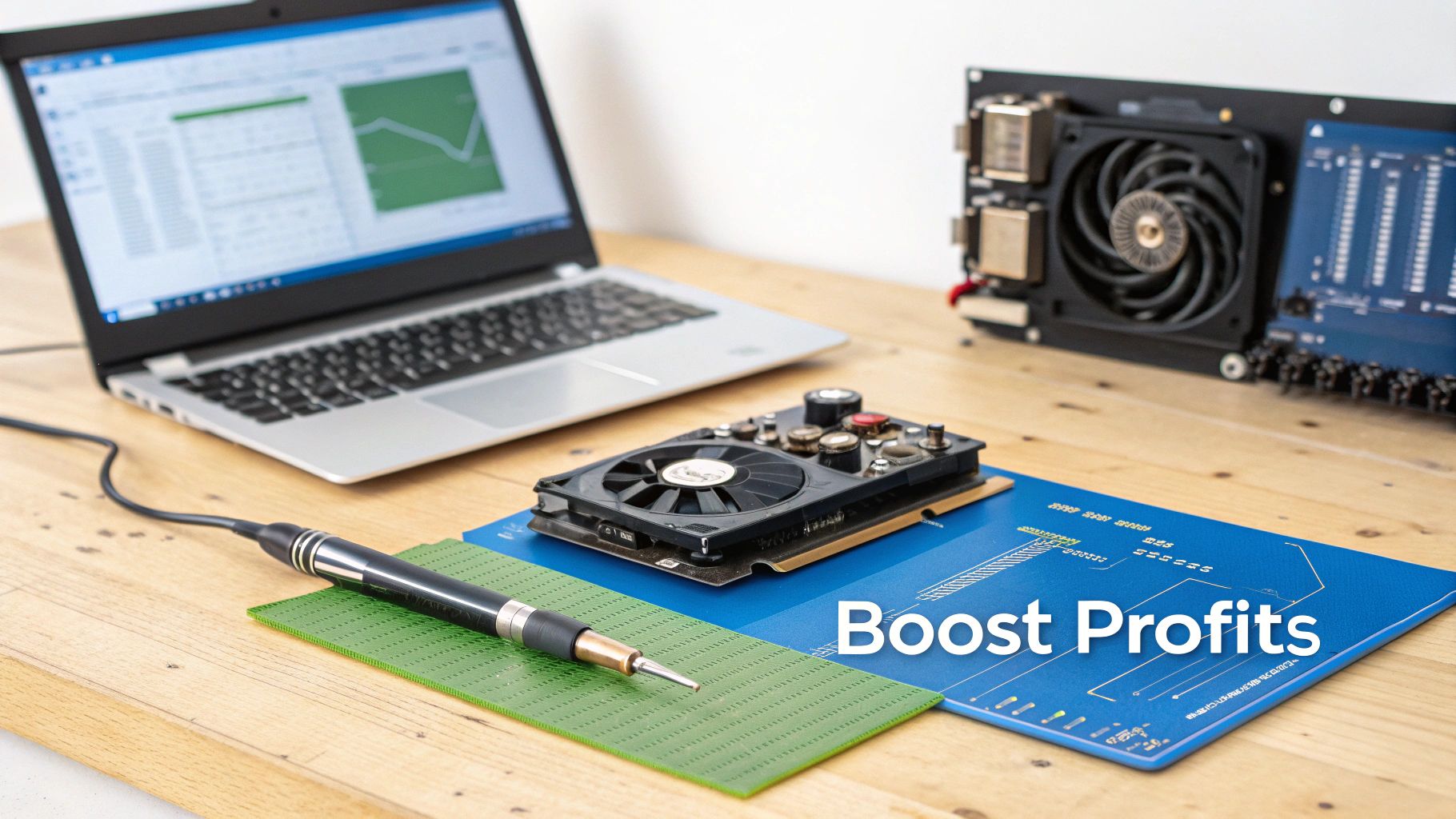
Once your rig is up and running, the real game begins. The line between a hobby that pays for itself and a truly profitable venture is drawn by active management and constant optimization.
Experienced miners know that “set it and forget it” is a recipe for mediocrity. They’re constantly tweaking, testing, and adapting their strategy to squeeze every last drop of performance from their hardware.
Strategic Coin and Algorithm Switching
Loyalty to a single coin is a surefire way to leave money on the table. The crypto market moves fast, and the most profitable coin to mine can change by the hour. A spike in a coin’s price or a drop in its network difficulty can instantly make it the top earner.
This is where smart miners stay nimble. They constantly run the numbers through profitability calculators to see which algorithm is paying the most for their specific hardware. Many modern mining software packages even have this feature built-in, automatically pointing your rig toward the most lucrative coin in real-time. Don’t mine what you like; mine what pays.
Overclocking and Undervolting for Peak Efficiency
Your GPU comes from the factory tuned for a gamer, not a miner. To unlock its true mining potential, you need to get under the hood with overclocking and undervolting. These are the two most critical adjustments you can make.
- Overclocking the Memory: Many mining algorithms are incredibly hungry for memory bandwidth. Pushing your GPU’s memory clock speed higher directly translates to a higher hashrate.
- Undervolting the Core: While the memory is working overtime, the GPU core often isn’t. By carefully reducing the voltage going to the core, you can slash power consumption and heat output with little to no impact on your hashrate.
Key Conclusion: The goal isn’t just the highest hashrate. The true metric of success is the hashrate-per-watt. A 5% jump in hashrate is a net loss if it costs you 20% more in electricity.
Finding that perfect balance of high memory clocks and low core voltage is an art form. But the payoff is huge, showing up directly as lower electricity bills and higher net profits. For more on picking the right hardware from the start, check out our guide on building an efficient GPU mining rig.
Cooling Optimization for Longevity and Stability
Heat is the ultimate enemy of a mining operation. It degrades performance and slowly kills your expensive hardware. When a GPU gets too hot, it protects itself by thermal throttling—automatically slowing down and tanking your hashrate.
Keeping things cool isn’t just a suggestion; it’s a requirement for stable profits. Here’s how:
- Ensure excellent airflow with an open-air frame or a well-ventilated case.
- On older cards, replace the thermal pads and paste to improve heat transfer.
- Set an aggressive fan curve in your tuning software to combat heat under load.
A cool card is a happy card. It runs faster, more consistently, and will last much longer.
Exploring Merged Mining Opportunities
Why settle for mining one coin when you could be mining two at the same time? Merged mining is a clever technique that lets you secure multiple blockchains simultaneously without splitting your hashrate. This works when a smaller “child” coin’s network accepts the proof-of-work being done for a larger “parent” coin.
A classic example is mining a Scrypt-based coin like Litecoin and getting Dogecoin for free. It’s an easy way to stack a second crypto asset with zero additional electricity cost or performance loss. It’s not available for every algorithm, but when it is, it’s a powerful way to add another revenue stream.
Taking a hands-on approach with these strategies is what separates the pros from the amateurs. Just look at the razor-thin margins in 2025: a four-card RTX 4090 rig might only generate $3.89 in daily revenue. This reality pushes the payback period to a grueling five-plus years, even with cheap power. As you can see, every watt you save and every fraction of a hash you gain truly matters.
Frequently Asked Questions (FAQ)
What is the best GPU for mining right now?
There is no single “best” card. The right GPU balances three key factors: purchase price, hashrate, and power efficiency. While a high-end card like the NVIDIA RTX 4090 offers the highest raw hashrate, its steep cost and high power draw can make its return on investment (ROI) period very long.
For most miners, the sweet spot lies with efficiency-focused cards like the NVIDIA RTX 4070 or RTX 3060 Ti. These models provide an excellent hashrate-per-watt, maximizing your earnings for every dollar spent on electricity. Always use a real-time calculator like WhatToMine with your local electricity rate before buying any hardware.
How much can I make per day with one GPU?
Daily earnings from a single GPU can fluctuate wildly, from a net loss to a few dollars in profit. Your actual income depends on:
- Your GPU model (e.g., RTX 4070 vs. RTX 3060)
- The coin you are mining (e.g., Ravencoin, Ergo, Kaspa)
- Current crypto market prices
- Your electricity cost
On a good day, a modern, efficient GPU might generate $1.00 to $2.50 in gross revenue. After subtracting daily electricity costs (which could be $0.50 to $1.50), your net profit is often quite slim. It’s crucial to check profitability daily using a live calculator.
Is GPU mining worth it with free electricity?
Access to free or extremely cheap electricity (under $0.05/kWh) is a game-changer. It eliminates your largest operational cost, meaning nearly all mining revenue becomes pure profit. This can make older, less efficient GPUs viable again.
However, “free electricity” doesn’t mean “free money.” You still have the significant upfront cost of the hardware. While your ROI timeline will be much shorter, you must calculate whether the potential daily earnings are enough to justify the initial investment in the GPU itself.
Do I need to pay taxes on mining profits?
Yes, absolutely. In most countries, including the US and in the EU, cryptocurrency earned from mining is treated as taxable income. The process typically involves two tax events:
- Income Tax: The fair market value of the coins at the moment you mine them is considered income and must be reported.
- Capital Gains Tax: If you later sell, trade, or spend those coins, you will owe capital gains tax on any appreciation in value from the date they were mined.
Tax laws for crypto are complex and vary by location. It is highly recommended to consult a qualified tax professional who specializes in digital assets. Keep detailed records of your mining activities, including dates, amounts, and market values, to ensure compliance.