Most Profitable Altcoin to Mine
When you’re hunting for the most profitable altcoin to mine, you’ll quickly realize the answer changes almost daily. What’s on top of the profitability charts one week can be old news the next. It’s a constant shuffle driven by market prices, network difficulty, and even miner sentiment.
The real secret isn’t finding a single “best” coin, but understanding how to find the best coin for your specific setup, right now. This guide will walk you through the key factors, compare the best hardware, and highlight the top contenders to help you make informed decisions and maximize your returns.
Your Quick Guide to Profitable Altcoin Mining
Pinpointing the right altcoin to mine often feels like trying to hit a moving target. Profitability is incredibly fluid, swayed by everything from the coin’s current market value to how many other miners are competing for the same rewards. Your goal shouldn’t be to just find a coin that’s profitable today, but to find one that makes sense for your hardware and your goals.
Think of this as your starting point. We’ve cut through the noise to highlight the current top contenders for both GPU and ASIC miners, giving you a solid, data-backed launchpad. Before we get into the nitty-gritty of the calculations, this overview will get you oriented. If you’re brand new to this world, our guide on how to start crypto mining is the perfect place to build your foundation.
Top Profitable Altcoins at a Glance
To give you a clearer picture, we’ve laid out some of the most consistently profitable altcoins below. This table breaks them down by their algorithm, the type of hardware they favor, and a general idea of their profitability. This is a high-level comparison designed to help you quickly see where your hardware might fit in the current mining landscape.
| Altcoin | Mining Algorithm | Best For (Hardware) | Key Advantage |
|---|---|---|---|
| Kaspa (KAS) | kHeavyHash | GPU | High block rate for frequent rewards |
| Dogecoin (DOGE) | Scrypt | ASIC (Merged with LTC) | Dual rewards through merged mining |
| Zcash (ZEC) | Equihash | ASIC / High-end GPU | Strong privacy features drive value |
| Ravencoin (RVN) | KAWPOW | GPU (ASIC-resistant) | Decentralized and community-focused |
This table provides a great snapshot, but remember these figures are always in flux. Use it as a guide to start your own research with a profitability calculator.
In summary: The title of “most profitable altcoin to mine” is never permanent. It’s a dynamic calculation that depends on matching the right coin to your specific hardware and electricity rate. GPU miners often find an edge with ASIC-resistant algorithms, while ASIC owners should focus on established, powerful algorithms like Scrypt.
Understanding How Mining Profitability Works
Before you start chasing the “most profitable” altcoin, you have to get a handle on what profitability really means in mining. It’s not a steady paycheck. It’s a moving target, constantly being pushed and pulled by a few powerful, interconnected forces. Think of it like a digital gold rush—the value of the gold, the number of other prospectors, and the cost of your pickaxe are all in constant flux.
At the center of it all is your hardware’s power, what we call hashrate. This is simply how fast your mining rig can churn through calculations to solve a block. The higher your hashrate, the more guesses you get per second, which directly increases your odds of finding that next block and claiming the reward.
The Core Factors of Profitability
But your hashrate is just one piece of the puzzle. It’s competing in an environment shaped by four other key variables that dictate your actual earnings. Getting a feel for how these factors play off each other is the first real step toward running a successful mining operation. It’s a delicate balance, as a shift in just one of these can completely change your daily returns.
Here are the four key factors you need to track:
- Network Difficulty: This is your competition, plain and simple. As more miners jump onto a network, the protocol automatically makes the math problems harder to solve. This keeps the block discovery rate stable. When difficulty goes up, your hashrate earns you a smaller slice of the pie.
- Block Rewards: This is the prize. When your hardware successfully mines a block, you get a set number of coins. But be aware, these rewards often get cut in half over time in events called “halvings,” which can seriously impact your long-term income stream.
- Coin Price: The market value of whatever altcoin you’re mining is a huge profit driver. You could be mining thousands of coins a day, but if they’re worth next to nothing, you’re just running a very expensive heater.
- Electricity Cost: This is the big one—the single largest operational cost and the ultimate profitability killer. A beast of a rig is totally useless if your power bill eats up more than the value of the coins you mine. Your rate, measured in dollars per kilowatt-hour ($/kWh), can make the exact same setup a cash cow in one location and a money pit in another.
The path you take with your hardware—whether you go with flexible GPUs or hyper-efficient ASICs—also shapes your strategy, as this diagram shows.
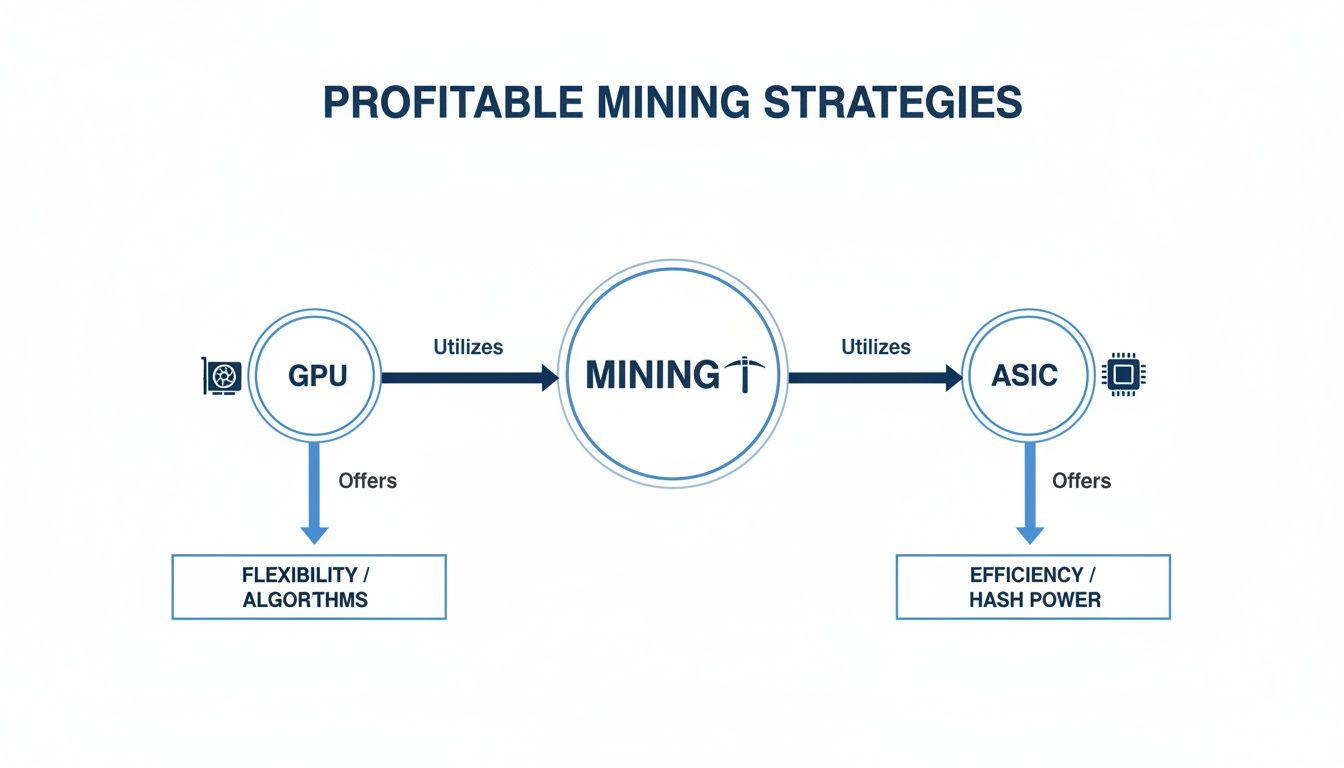
This highlights how your initial choice between GPUs and ASICs sets the stage, determining which of those profitability factors will matter most to you down the line.
Calculating Your Potential Earnings
So, with all these moving parts, how do you figure out what you could actually make? This is where a good calculator becomes your best friend.
Trying to track all of this manually is a fool’s errand. The data changes too quickly. You need a reliable tool that plugs into real-time data for coin prices, network difficulty, and block rewards to give you an accurate snapshot.
The main takeaway is this: Real profitability is your total revenue (Block Rewards × Coin Price) minus your operational costs (mostly electricity). If you ignore any part of that formula, you’re flying blind with an incomplete and often misleading picture of your potential returns.
Our detailed guide on using a crypto mining profitability calculator shows you exactly how to punch in your specific hardware specs and electricity cost to get a clear forecast. It’s the only way to reliably find the most profitable altcoin to mine for your specific situation.
Choosing Your Hardware: GPU vs. ASIC Mining
The single most important decision you’ll make as a miner is your hardware. It’s the foundational choice that dictates which coins you can mine, how efficiently you can do it, and how you’ll have to adapt to the market. Picking the most profitable altcoin isn’t just about the coin itself—it’s about pairing the right algorithm with the right tool for the job.
The crypto mining world is split into two main camps: Graphics Processing Units (GPUs) and Application-Specific Integrated Circuit (ASIC) miners.
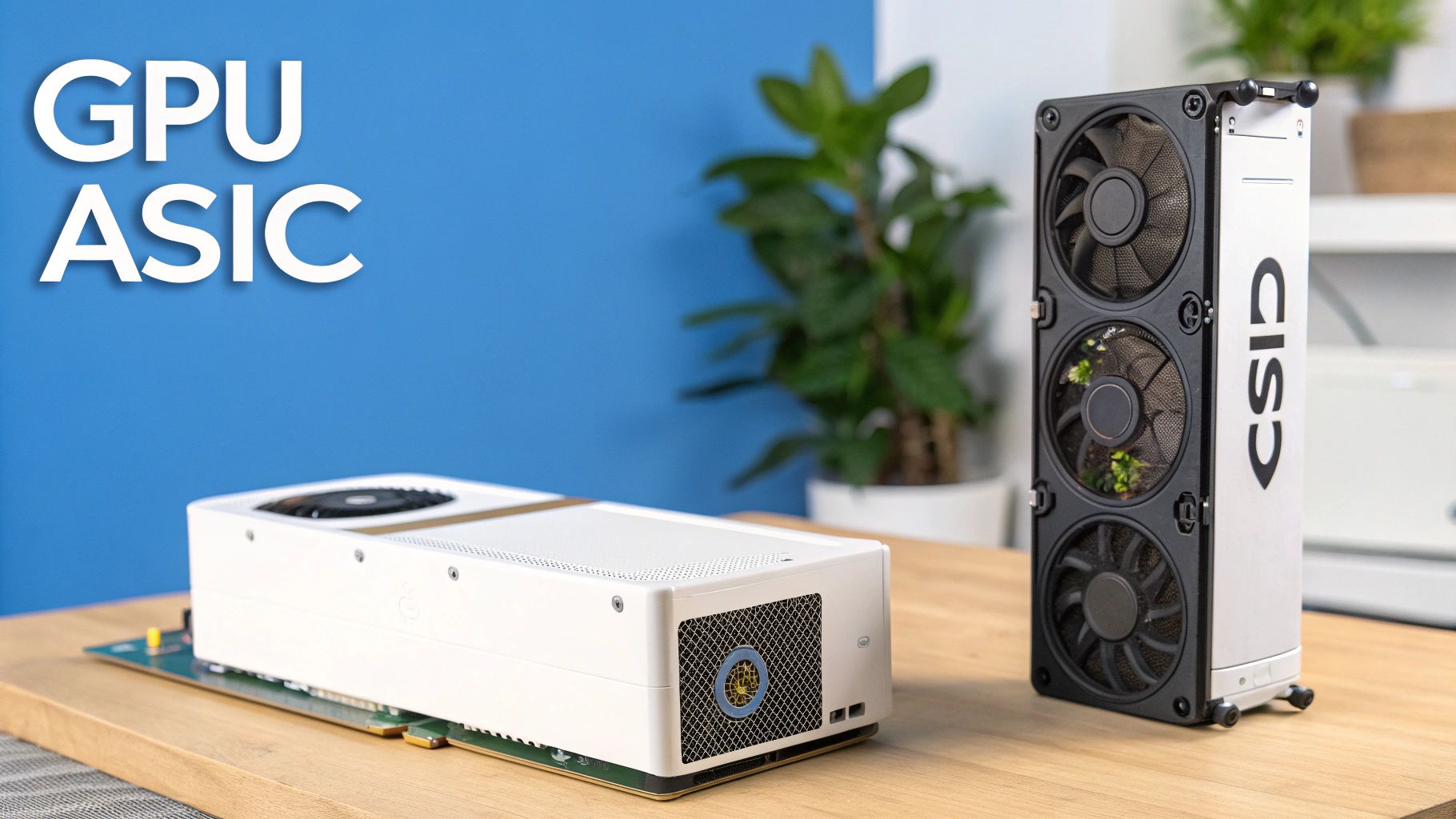
Think of a GPU as a master chef’s knife set. It’s incredibly versatile, capable of dicing, slicing, and chopping a huge variety of ingredients. An ASIC, on the other hand, is like an industrial apple-coring machine—it does one specific task with blistering, unmatched speed, but it can’t do anything else. This core difference will shape your entire mining strategy.
The Case for GPU Mining: Flexibility and Accessibility
For most people dipping their toes into mining, GPUs are the natural starting point. Their biggest selling point is flexibility. A GPU rig isn’t married to one coin. If the altcoin you’re mining crashes in price or the network difficulty skyrockets, you can pivot in minutes by simply switching software and pointing your hash power toward a more profitable opportunity. In a volatile market, that agility is a massive advantage.
On top of that, a whole class of altcoins is intentionally designed to be ASIC-resistant. Developers use algorithms like KAWPOW (Ravencoin) specifically to keep massive, purpose-built ASIC farms from centralizing the network. This levels the playing field, giving smaller, at-home miners a real shot at earning rewards.
The Power of ASIC Mining: Raw Efficiency and Dominance
Then you have the ASICs. These machines are engineered from the silicon up for one mission: to mine a specific algorithm faster than anything else. An ASIC built for the Scrypt algorithm, for instance, will mine Dogecoin or Litecoin hundreds of times more efficiently than the most powerful GPU rig.
But that brutal efficiency comes at a cost. ASICs are expensive, noisy, and generate a ton of heat, making them a poor fit for a home office. Most importantly, if the coin your ASIC is designed for becomes unprofitable, you’re left with a very expensive paperweight.
Hardware Showdown: A Clear Comparison
To help you decide, here’s a side-by-side breakdown of the key differences that will directly impact your profitability and experience.
| Factor | GPU Mining | ASIC Mining |
|---|---|---|
| Flexibility | High: Can switch between multiple algorithms and coins. | Extremely Low: Locked to a single algorithm. |
| Upfront Cost | Lower: You can start small with one or two cards and scale up. | High: Single units are expensive, requiring a significant initial investment. |
| Efficiency | Moderate: Good performance-per-watt but can’t match an ASIC. | Very High: Optimized for maximum hashrate with minimal power use. |
| Resale Value | Strong: Always in demand for gamers and creators. | Limited: Only valuable to other miners on the same algorithm. |
| Best For | ASIC-resistant coins like Ravencoin (RVN), Kaspa (KAS). | Established algorithms like Scrypt (DOGE), Equihash (ZEC). |
The final verdict: Your hardware choice is a strategic trade-off. GPUs give you the freedom to chase new, promising altcoins and adapt on the fly. ASICs offer the raw power to dominate the most established networks. The right call comes down to your budget, your tolerance for risk, and what you’re trying to achieve long-term.
Best Altcoins for ASIC Miners
If you’ve invested in an Application-Specific Integrated Circuit (ASIC) miner, you’re playing a different game. These aren’t jack-of-all-trades GPUs; they are highly specialized machines built to crush a specific mining algorithm like Scrypt or Equihash.
Your path is already chosen by your hardware. The trick isn’t finding a new, trendy coin—it’s pointing your rig at the most lucrative network that speaks its language. Your goal is to turn that massive hashrate into a steady stream of rewards from established, valuable coins.
Dogecoin and the Power of Merged Mining
It might surprise you, but Dogecoin (DOGE) is often a top earner for anyone running a Scrypt-based ASIC. This is largely thanks to its symbiotic relationship with Litecoin (LTC) through a strategy called merged mining.
Because both coins run on the Scrypt algorithm, you can mine them simultaneously without losing any efficiency. Think of it as getting two paychecks for the effort of one. When you connect your Scrypt ASIC to a supportive mining pool, you solve hashes that validate transactions on both blockchains at the same time, earning full rewards for both Litecoin and Dogecoin. This two-for-one deal is a massive profitability boost.
Key takeaway: Merged mining isn’t just a small bonus; it’s a fundamental profit multiplier for Scrypt miners. If you’re not doing it, you are leaving a serious amount of money on the table every single day. You can dig into the live profitability numbers for different hardware over at ASIC Miner Value.
Zcash: A Strong Contender for Equihash Miners
If your ASIC is built for the Equihash algorithm, then Zcash (ZEC) should be at the top of your list. While some powerful GPUs can technically still mine it, modern Equihash ASICs have such a massive performance advantage that it’s not really a fair fight.
Zcash’s staying power comes from its core feature: privacy. It gives users the option to conduct “shielded” transactions that hide the sender, receiver, and transaction amount. That level of anonymity is a powerful draw that creates sustained demand for ZEC and helps support its market price.
Here’s how these two ASIC-friendly heavyweights stack up:
| Feature | Dogecoin (DOGE) | Zcash (ZEC) |
|---|---|---|
| Algorithm | Scrypt | Equihash |
| Key Advantage | Merged mining with Litecoin (LTC) | Strong privacy features driving demand |
| Target Hardware | Scrypt ASICs (e.g., Antminer L series) | Equihash ASICs (e.g., Antminer Z series) |
| Reward Strategy | High volume, dual-coin rewards | Value driven by unique utility |
In summary: Your decision comes down to the hardware you own. If you have a Scrypt miner, the Dogecoin-Litecoin combo is a no-brainer. If you’re running an Equihash machine, Zcash offers a solid, value-driven alternative. Either way, you’re using specialized gear to gain a crucial edge in securing these valuable networks.
Best Altcoins for GPU Miners
If you’re a miner who values flexibility, a good GPU rig is still your best friend. Unlike ASICs, which are hardwired to mine just one specific algorithm, GPUs can switch targets on the fly. This agility is your biggest advantage, letting you chase profitability wherever it pops up.
The trick is to hunt for coins specifically designed to be ASIC-resistant. Developers build these projects with algorithms that keep the big, industrial-scale mining farms from cornering the market, which keeps the door open for home and small-scale miners to compete and earn real rewards.
Kaspa: A GPU Favorite for a Reason
Right now, Kaspa (KAS) is a top choice for GPU miners. It’s built on the kHeavyHash algorithm and a unique ledger structure called a blockDAG. While a normal blockchain adds blocks one at a time in a single line, Kaspa’s blockDAG processes multiple blocks at once, like a multi-lane highway.
This parallel processing leads to lightning-fast confirmations—about one block per second. For a miner, that means you find blocks and get paid far more often. Instead of waiting hours for a big reward, you get a steady stream of smaller payouts, which makes for a much more predictable income.
Don’t Put All Your Hashrate in One Basket
While Kaspa is a solid choice, any seasoned miner will tell you not to go all-in on a single coin. Smart diversification is the name of the game. Spreading your hashrate around helps maximize your earnings and protects you when one coin’s value takes a dip.
Here are a few other excellent options to point your GPU rig at:
- Ravencoin (RVN): Running on the KAWPOW algorithm, Ravencoin is fiercely ASIC-resistant by design. It was built for asset transfers and is backed by a passionate community committed to keeping the network decentralized.
- Ethereum Classic (ETC): When Ethereum moved to Proof-of-Stake, Ethereum Classic stuck with the original Proof-of-Work model. It uses the Etchash algorithm, which is a great fit for GPUs with at least 6GB of VRAM.
- Zcash (ZEC): Although ASICs have an advantage here, high-end GPU rigs can still mine Zcash profitably. The coin’s strong privacy features create real-world demand. In fact, Zcash (ZEC) was a top earner for both GPU and Equihash ASIC miners in 2025, largely because its privacy-first approach is popular in regulated markets across the EU and Asia. To give you a concrete example, as of November 2025, a 12-GPU rig of RTX 4090s was pulling in $22.10/day—a full 76% more than Ravencoin at the time. You can dig into more of these profitable mining machine findings for a deeper dive.
This table breaks down how these top GPU coins stack up.
| Altcoin | Mining Algorithm | Key Feature | Best For Miners Seeking |
|---|---|---|---|
| Kaspa (KAS) | kHeavyHash | High block rate (blockDAG) | Frequent, consistent rewards |
| Ravencoin (RVN) | KAWPOW | Strong ASIC resistance | A decentralized, community-driven project |
| Ethereum Classic (ETC) | Etchash | Established network and brand | A stable alternative to former ETH mining |
| Zcash (ZEC) | Equihash | Privacy and anonymity | A value-driven coin with strong demand |
The bottom line: Kaspa’s rapid block rate makes it a fantastic environment for consistent rewards. However, the best tool is a real-time profitability calculator. Plug in your specific GPU model and electricity cost, and it will tell you exactly which coin is offering the best return right now. This is how you truly take advantage of the flexibility your hardware gives you.
Strategies to Squeeze Every Last Drop of Profit from Your Mining Rig
Pinpointing a profitable altcoin is a great start, but it’s only half the battle. To turn that potential into actual, consistent returns, you need a smart approach. The first, and arguably most important, decision you’ll make is whether to mine solo or join a mining pool. For virtually everyone, the answer is a no-brainer: join a pool.
Think of solo mining like buying a single Powerball ticket—the odds of winning are brutal. A mining pool is like an office lottery group where everyone chips in. This drastically improves the chances of winning, and the prize is split among the contributors. It transforms a game of pure luck into a much more predictable and steady trickle of income.
How to Pick the Right Mining Pool
Choosing a pool isn’t just about finding the one with the lowest fee. You have to look under the hood at the payout model, fee structure, and even server location.
When you’re comparing your options, keep these three things front and center:
- Payout Structure: Most pools use a Pay-Per-Share (PPS) or Pay-Per-Last-N-Shares (PPLNS) model. PPS is the most stable—you get paid for every valid share you submit, regardless of whether the pool finds a block. PPLNS only pays out when the pool finds a block, which means your income can be lumpier but might average out to be slightly higher long-term.
- Fee Percentage: Fees typically range from 0.5% to 2.0%. It’s tempting to go for the lowest number, but a massive, reliable pool that finds blocks constantly might be worth a slightly higher fee than a smaller, less consistent pool.
- Server Location: Latency matters. Choosing a pool with servers close to you geographically reduces the communication delay between your rig and the pool, which means fewer “stale” shares and higher earnings.
Advanced Tactics for Pro Miners
Once you’ve got the hang of pool mining, you can start exploring some more advanced techniques to boost your bottom line.
One of the most powerful is profit-switching. This involves using specialized software that constantly scans the market in real-time and automatically points your hardware to whichever coin is the most profitable to mine at that exact moment. It’s a hands-off way to ensure your rig is always performing the highest-value work.
Finally, you need a clear exit strategy for your mined coins. Are you going to “HODL” for the long term, or will you sell a portion regularly to cover your electricity bill and lock in gains? Thinking through this final step is what elevates your mining from a technical hobby to a real business.
In conclusion: Joining a well-vetted mining pool is the bedrock of any profitable operation. The stability it offers is far more valuable than the long-shot chance of a solo jackpot. From there, using advanced tools like profit-switching software can further automate and maximize your returns.
FAQ: Common Questions About Profitable Altcoin Mining
What is the most profitable crypto to mine right now?
The answer changes constantly due to market fluctuations. For GPU miners, coins like Kaspa (KAS) and Ravencoin (RVN) are often top contenders due to their ASIC-resistant algorithms. For ASIC miners, the most profitable option is usually determined by their hardware; for example, Scrypt miners often find a combination of Dogecoin (DOGE) and Litecoin (LTC) through merged mining to be the most lucrative. The only way to know for sure is to use a real-time crypto mining profitability calculator.
Can you still mine crypto with a CPU?
Technically, yes, but it is almost never profitable. CPU mining was viable in the very early days of cryptocurrency, but today’s network difficulties are far too high for a standard processor to compete. Projects like Monero (XMR) are designed to be CPU-mineable, but even then, the returns are typically not enough to cover the electricity costs. For serious mining, you need a GPU or an ASIC.
How much can I earn mining altcoins?
Your earnings depend entirely on three factors:
- Your hashrate (the power of your hardware).
- Your electricity cost (measured in $/kWh).
- The current market conditions (coin price and network difficulty).
A high-end GPU rig in an area with cheap electricity could earn anywhere from a few dollars to over $20 per day, while a powerful ASIC could earn significantly more. However, in an area with high electricity costs, the same hardware could operate at a loss. Always calculate your potential profit after costs.
Which is better for a beginner, GPU or ASIC mining?
For most beginners, GPU mining is the better starting point.
- Lower Upfront Cost: You can start with a single graphics card and scale up over time.
- Flexibility: If one coin becomes unprofitable, you can easily switch to another.
- Resale Value: GPUs have a strong secondary market for gamers and creators.
ASICs are more suited for experienced miners with a larger budget who are willing to commit to a single algorithm and have a dedicated space to handle the noise and heat.
How do I reduce my mining electricity costs?
Lowering your power bill is the single best way to increase your profits. Here are a few strategies:
- Undervolt your hardware: Use software like MSI Afterburner to reduce the power consumption of your GPUs without significantly impacting their hashrate.
- Find a better electricity plan: Some utility providers offer lower rates during off-peak hours.
- Improve cooling: A well-ventilated space means your hardware’s fans don’t have to work as hard, which saves a small amount of power and prolongs the life of your equipment.