What Is a Mining Pool?
A mining pool is essentially a team of crypto miners who agree to combine their computing power. Why? To vastly improve their chances of finding a block and earning a reward.
Think of it like a lottery syndicate. You could buy one ticket and hope for a miracle, or you can join a group that buys thousands of tickets and agrees to split the winnings. In short, the pool takes the high-risk, high-reward gamble of solo mining and turns it into a much more consistent and predictable stream of income.
Why Mining Pools Are Essential for Modern Miners
Back in the early days of Bitcoin, you could actually make a profit mining on a regular home computer. Those days are long gone. As cryptocurrency networks have grown, so has the mining difficulty—a built-in mechanism that controls how hard it is to find a new block. Today, the odds of a solo miner finding a block on a major network are astronomically low. We’re talking years, maybe even decades, of waiting.
This is exactly the problem mining pools were created to solve. By pooling the hashrate (the total computational power) of thousands of individual miners, the group can find and solve blocks far more frequently. When the pool successfully mines a block, the reward is split among all the members, with each person getting a share proportional to the work they contributed.
To summarize, this system creates a steady flow of smaller payments instead of a single, massive jackpot that might never come.
The Shift from Solo Gamble to Pooled Consistency
The whole idea of pooled mining came about as a direct response to the rising difficulty and sheer unpredictability of going it alone. This fundamental shift kicked off with the launch of the first-ever public pool, Slush Pool (now known as Braiins Pool), way back in late 2010. By bringing hashrate together, pools turned a multi-year waiting game into a source of reliable payouts, making mining a practical venture for individuals once again.
You can learn more about how it all started in our detailed guide to crypto mining.
A mining pool smooths out the randomness of mining rewards. Instead of a 0.0001% chance of earning a huge reward on your own, you get a 100% chance of earning your 0.0001% share of the pool’s frequent rewards.
Solo Mining vs Pool Mining at a Glance
For almost everyone getting into mining today, the choice is pretty clear. The incredible amount of luck needed to succeed as a solo miner just isn’t practical. Pool mining, on the other hand, offers a dependable way to earn from your hardware.
This table breaks down the fundamental trade-offs.
| Attribute | Solo Mining | Pool Mining |
|---|---|---|
| Reward Frequency | Extremely low and unpredictable; could take years to find one block. | High and consistent; payouts can occur daily or even multiple times a day. |
| Income Stability | Very high risk with no guaranteed income. | Low risk with predictable, stable income based on contributed hashrate. |
| Hardware Requirement | Requires an immense amount of hashrate to be competitive. | Accessible to miners with even a single GPU or ASIC. |
| Reward Size | You keep the full block reward and all transaction fees if you find a block. | You receive a small fraction of the block reward, proportional to your work. |
The key takeaway is that joining a mining pool is the standard for virtually all miners. It takes the lottery-like gamble out of the equation and provides the financial predictability you need to run a profitable operation. That’s why platforms like MiningPoolStats exist—to give you the data to compare these pools and find the perfect fit for your hardware and goals.
Understanding How a Mining Pool Operates
To get a real feel for what a mining pool does, think of the pool operator as a general contractor on a massive construction project. The blockchain network posts a blueprint for a complex structure (the block), and the first crew to build it correctly gets a huge payout (the block reward).
Going it alone would be like one person trying to build a skyscraper. It’s technically possible, but the odds are astronomically against you. The contractor (the pool) doesn’t ask one worker to do it all. Instead, they break the massive blueprint down into thousands of smaller, manageable jobs—like framing a single wall or pouring a section of the foundation.
In the world of mining, these smaller jobs are called shares.
The Role of Shares and Hashing Power
The mining pool hands out these shares to all the miners connected to its network. Your mining rig—whether it’s a high-end ASIC or just your gaming PC’s GPU—is constantly receiving and working on these smaller computational tasks.
Every attempt your hardware makes to solve a share is a “hash.” The combined speed of all the miners crunching these numbers together is the pool’s total hashrate. A higher hashrate simply means the crew is working faster, trying more combinations, and dramatically increasing the odds that someone in the group will find the solution to the main puzzle.
This flow, from individual effort to a collective reward, is what makes pool mining so effective.
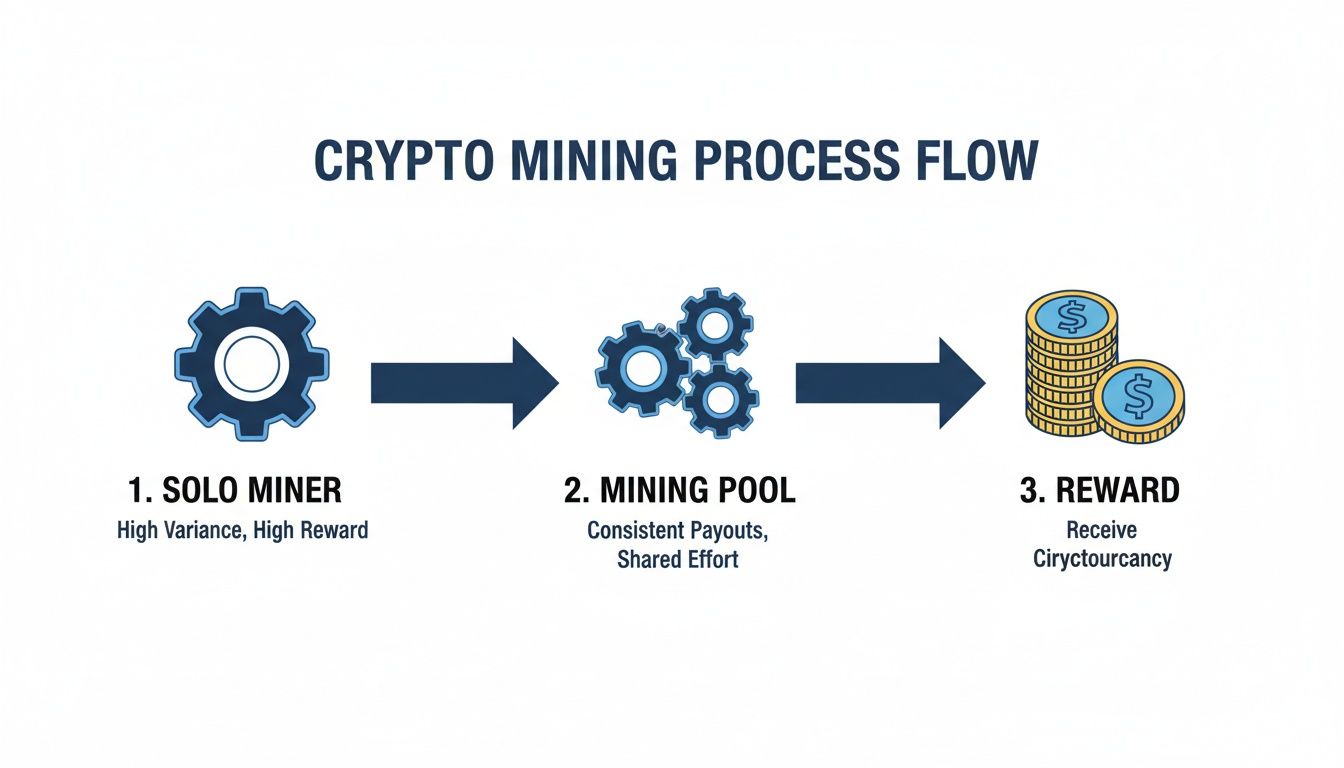
As the diagram shows, joining a pool turns mining from a lottery-like gamble into a steady, collaborative effort with predictable returns.
Submitting Proof of Work
As your mining software works through the shares, it’s not just solving them in silence. It’s constantly reporting back to the pool. When your rig finds a valid solution for one of these mini-problems, it submits that proof of work to the pool operator.
The pool then checks your work. This valid share is your proof that you’re actively contributing to the project and not just slacking off. It’s the equivalent of a worker showing the contractor they’ve completed their assigned task.
The crucial point here is that you earn credit for the valid shares you submit, regardless of whether your share was the one that solved the block. The pool uses this constant stream of submitted shares to track exactly how much work you’re doing.
This share-based system is the foundation for fair payouts. The pool keeps a meticulous record of every valid share from every single miner.
Hitting the Jackpot and Sharing the Spoils
Eventually, one of the millions of shares submitted by a miner in the pool will be the golden ticket—the one that also solves the entire block. When that happens, the entire pool wins.
The pool operator broadcasts the solution to the network, collects the block reward (the newly created coins plus all the transaction fees in that block), and gets ready to divide the earnings among the whole crew.
How is it divided? It all comes back to the shares.
- Miners with more powerful hardware (more hashrate) will naturally solve and submit more shares.
- By submitting more shares, they account for a larger percentage of the pool’s total effort.
- A larger slice of the work earns them a proportionally larger slice of the reward pie.
In conclusion, a mining pool coordinates thousands of miners, tracks their individual contributions with precision, and makes sure everyone gets their fair cut when the collective effort pays off. It takes the chaotic, unpredictable nature of solo mining and smooths it out into a reliable stream of income.
Decoding Pool Payout Models and Fee Structures
The real engine of any mining pool is its payout model—the set of rules dictating how you get paid for your hashrate. Getting this choice right is crucial because it directly shapes your income stability and overall earnings.
Think of it like choosing between a steady salary and a high-stakes commission job. Each path has its own trade-offs between risk and reward, and what works for one miner might not work for another. Understanding these models is the only way to get a realistic forecast of your profits.
The Salaried Job Models: PPS and FPPS
The Pay-Per-Share (PPS) model is as straightforward as it gets. It’s the salaried job of the mining world. You get paid a fixed, predictable rate for every valid share your hardware submits, period. It doesn’t matter if the pool finds a block or not. In this scenario, the pool shoulders all the risk. To cover that risk, PPS pools naturally charge higher fees.
An popular evolution of this is Full-Pay-Per-Share (FPPS), often called PPS+. This model also pays a guaranteed rate per share but sweetens the deal by adding a cut of the transaction fees from any blocks the pool does find. It gives you the same rock-solid stability as PPS but with a little extra earnings potential, making it a favorite for risk-averse miners.
The Commission Model: PPLNS
On the other side of the spectrum is Pay-Per-Last-N-Shares (PPLNS), which feels much more like a commission-based role. You only get paid when the pool actually finds a block. When that happens, the total reward is split among miners based on how many shares they contributed within a recent “window” of work.
This model introduces a lot more variance into your income stream.
- Good Luck: If the pool gets lucky and finds blocks more often than statistically expected, your payouts can be significantly higher than they would be on a PPS plan.
- Bad Luck: But if the pool hits a dry spell, so does your income. It can be a long wait between paydays.
Over the long haul, PPLNS can often be more profitable because the fees are much lower, but it demands patience. You have to be willing to ride out the inevitable ups and downs.
Comparison of Common Mining Pool Payout Models
Choosing the right model really boils down to your personal risk tolerance and financial strategy. Do you need predictable income to cover electricity costs, or can you afford to wait for a larger, less frequent payout? This table breaks down the core differences to help you decide.
| Payout Model | How It Works | Typical Fee Range | Payout Variance | Best For |
|---|---|---|---|---|
| PPS | Guaranteed payment for every valid share submitted. | 2% – 4% | Very Low | Miners who need predictable, stable income and want to avoid risk. |
| FPPS/PPS+ | Guaranteed payment per share plus a portion of transaction fees. | 1% – 3% | Low | Miners seeking stable income but with a small potential upside. |
| PPLNS | Payouts are made only when a block is found, based on recent shares. | 0% – 2% | High | Long-term miners who are comfortable with income volatility for potentially higher rewards. |
| SOLO | You get the full block reward, but only if you find a block yourself. | 1% – 2% | Extreme | Large-scale mining farms with enough hashrate to compete alone. |
The trade-off is clear: higher fees buy you stability and peace of mind, while lower fees open the door to higher potential rewards but come with much greater volatility. You can use a crypto mining profitability calculator to run the numbers and see how these different fee structures might impact your specific setup over time.
Uncovering Hidden Costs and Thresholds
The headline fee isn’t the whole story. Other factors can quietly eat away at your earnings, so you need to read the fine print. Two key things to watch for are:
- Withdrawal Fees: Some pools charge a small fee every single time you transfer your earnings out to your personal wallet, which can add up.
- Minimum Payout Threshold: This is the smallest amount of crypto you have to earn before the pool will process a payment. For smaller-scale miners, a high threshold can be a real headache, as it could take weeks or even months to hit the minimum, leaving your funds locked up and out of reach.

When you combine the payout model, all associated fees, and the pool’s specific payment policies, you can finally build an accurate picture of what you can expect to earn.
The Strategic Choice Between Large and Small Pools
Picking a mining pool is more than just comparing fees. It’s a strategic move that hinges on the pool’s size, and your choice has real consequences for both your wallet and the health of the entire crypto network.
Think of it like deciding where to go fishing. You could head to a massive, well-stocked lake or a small, private pond. In the big lake, you’re almost guaranteed to catch something, even if it’s just a bunch of small fish. The little pond? You might not get a bite for days, but when you do, you could land a monster.
The Case for Large Mining Pools
The big players—pools like Foundry USA, AntPool, and ViaBTC—have one massive advantage: consistency. They command such a huge slice of the global hashrate that they find blocks with stunning regularity, often multiple times an hour. For a miner, this means predictable, steady payouts. If you’re trying to cover electricity bills and other operational costs, a large pool is the safe, reliable choice.
Network Health and the Risk of Centralization
But there’s a catch. The dominance of these giants raises a serious question for the entire crypto ecosystem: centralization. The very security of a proof-of-work blockchain like Bitcoin is built on the idea that hashing power is spread out among countless independent miners. When too much of that power gets concentrated in one place, it creates risk.
The top five pools often control more than 60% of Bitcoin’s total hashrate. If any single entity were to control over 50% of the network, they could theoretically launch a “51% attack” and start manipulating the blockchain. You can dig deeper into hashrate distribution and network security to understand the implications.
While a reputable pool launching a 51% attack is extremely unlikely—it would destroy their own business and the value of the coin they’re mining—the mere possibility goes against the core ethos of cryptocurrency. Supporting a more distributed hashrate is essential for the network’s long-term security.
The Argument for Small Mining Pools
Choosing a smaller pool is, in a way, a vote for decentralization. By pointing your hashrate toward a less dominant player, you’re actively helping to spread out mining power and make the whole network more resilient.
Financially, small pools offer a completely different risk-reward dynamic:
- Less Frequent Payouts: A small pool could go days, maybe even weeks, without finding a block.
- Larger Payouts: But when the pool does get lucky and finds a block, your piece of the pie is much bigger because the reward is split among fewer miners.
- Higher Variance: This creates a much more volatile income stream—long stretches of nothing, punctuated by the occasional big payday.
In summary, siding with a smaller pool demands patience and the financial stability to ride out the lean times. It’s a strategy for miners who aren’t living off daily payouts and feel a sense of responsibility for contributing to a more robust, secure digital economy.
How to Choose the Right Mining Pool for Your Goals
Alright, you’ve got the theory down—you know the difference between payout models and why pool size matters. Now it’s time to put that knowledge to work and actually pick a pool. This isn’t about finding some mythical “best” pool; it’s about finding the one that’s the right fit for you—your hardware, your risk tolerance, and your financial goals.

Let’s walk through a practical checklist to turn all that theory into a clear, actionable strategy.
1. Evaluate Payout Model and Fees
The pool’s payment system is where the rubber meets the road. It directly controls the stability of your income, making this your most critical decision.
- For Maximum Stability: If you need consistent cash flow, look for a pool with a PPS or FPPS model. The fees are higher, usually in the 1% to 4% range, but you get paid for every single share you contribute, guaranteed.
- For Higher Long-Term Potential: If you have the patience and can handle some dry spells, a PPLNS pool is your best bet. Fees are incredibly low (often 0% to 2%), but payouts only happen when the pool finds a block.
Key Takeaway: Don’t get fooled by the fee percentage alone. A 1% PPLNS pool and a 3% FPPS pool are apples and oranges. You’re choosing a risk profile, not just a fee. Match the model to your financial reality first, then compare fees between similar pools.
2. Analyze Pool Size and Server Location
A pool’s infrastructure is just as important as its payout model. It dictates both the reliability of your payouts and the efficiency of your hardware. A massive pool with a high hashrate finds blocks more often, leading to more frequent payouts—a big plus, especially for PPLNS miners.
But just as crucial is where their servers are physically located. Your mining rig is in constant communication with the pool, and distance matters. The further that data has to travel, the higher your latency. Always pick a pool with a server geographically close to you to reduce “stale shares”—work your rig completed that arrived just a fraction of a second too late to count.
3. Check Reliability and Reputation
You’re about to trust a pool with your valuable hashrate, so a little due diligence goes a long way. A pool’s track record is the best predictor of its future performance.
- Uptime History: Look for pools that can prove a history of near-perfect uptime—think 99.9% or better. Any downtime is time your rigs are sitting idle, which means lost revenue.
- Community Reputation: Jump into forums on Reddit or Discord and just listen. How do people talk about the pool’s support team? Are payments consistently on time? A pool with a great community reputation is a very good sign.
- Minimum Payouts: Check the pool’s minimum payout threshold. If it’s too high for your operation, your hard-earned crypto could be stuck in the pool’s wallet for weeks or even months before you can touch it.
Once you’ve weighed these factors and made a decision, getting started is usually pretty straightforward. For a detailed guide on configuring your software, take a look at our article on how to join a mining pool.
By taking a systematic approach, you can confidently choose a pool that not only maximizes your earnings but also gives your hard-working hardware a stable and profitable home.
Frequently Asked Questions (FAQ)
What is the main purpose of a mining pool?
The main purpose of a mining pool is to allow individual miners to combine their computing power (hashrate) to increase their collective chance of finding a block and earning cryptocurrency rewards. It transforms mining from a lottery-like gamble with a very low chance of success into a reliable source of income through shared effort and shared rewards.
How often do mining pools pay out?
Payout frequency depends on the pool’s specific policy and your contributed hashrate. Most pools use an automated system that pays out once your earnings reach a set minimum threshold (e.g., 0.001 BTC). For large miners, this can happen multiple times a day. For smaller hobbyist miners, it might take several days or weeks to reach the payout threshold.
Is it difficult to switch between mining pools?
No, switching is very easy and takes only a few minutes. You simply need to update the configuration settings in your mining software with the new pool’s server address (stratum URL) and your new worker credentials. You are never locked into a single pool. Just remember to cash out any remaining balance from your old pool before you switch.
Is it safe to give my wallet address to a mining pool?
Yes, it is completely safe and necessary for you to get paid. Your public wallet address is like a bank account number; it can only be used to receive funds, not to withdraw them. A legitimate mining pool will never ask for your private keys or seed phrase. If one does, it’s a major red flag. For extra security, use a strong password and enable two-factor authentication (2FA) on your pool account.
What happens if a mining pool gets hacked?
While rare for reputable pools, a hack poses two main risks: loss of unpaid earnings and mining downtime. The biggest risk is losing funds held in the pool’s “hot wallet” for daily operations. To mitigate this, established pools keep most funds in secure offline cold storage. A hack could also cause the pool to go offline, meaning your miners stop earning until service is restored. This is why choosing a pool with a strong security track record is critical.